
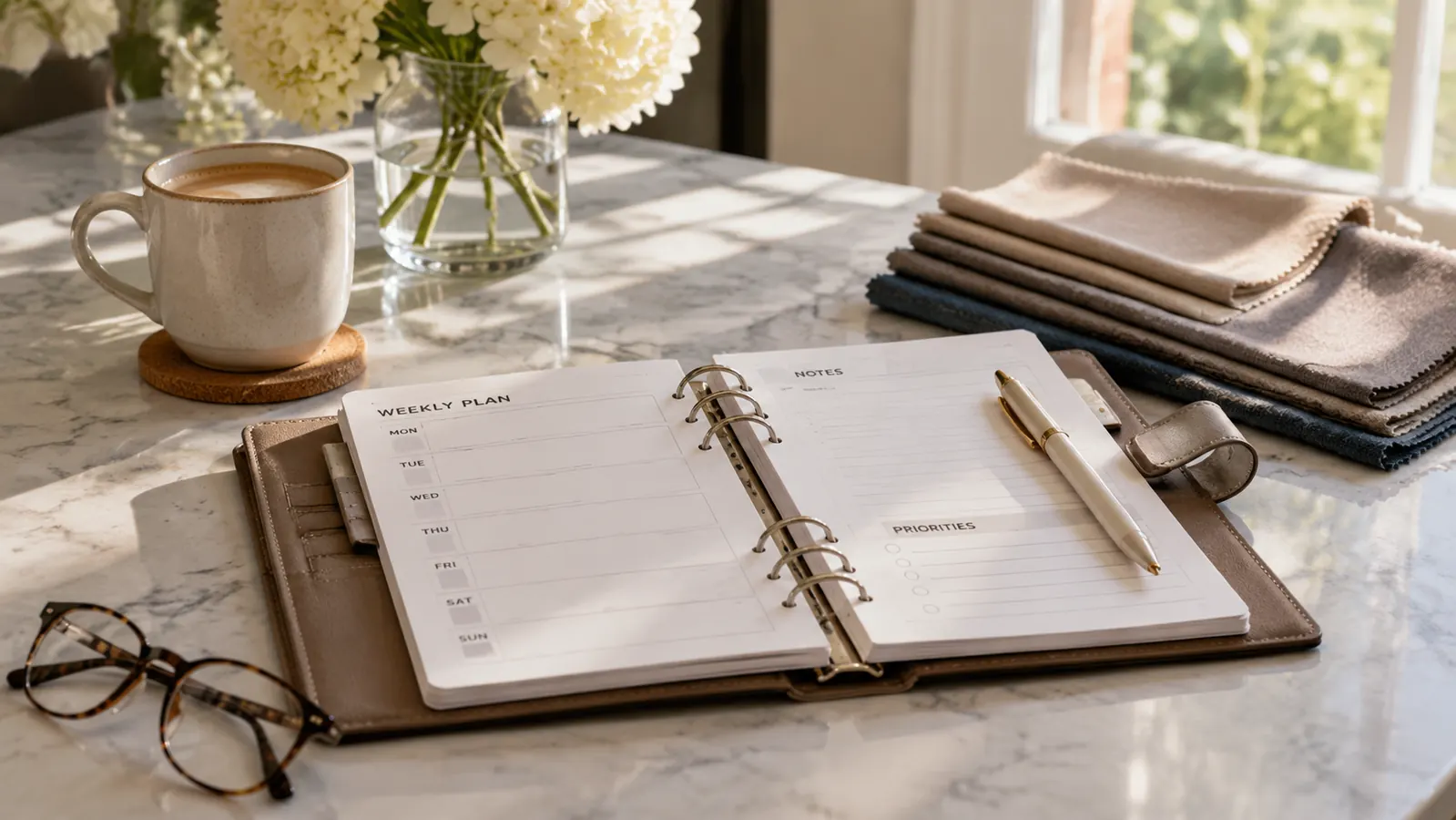
I bought The Knot planner the first week of December, the week after my daughter Elise got engaged. I am not a wedding planner. I am a retired school office manager in Savannah, Georgia, and the only wedding I have ever run was hers: 72 guests, 9 round tables of 8, a Saturday in June at a small inn outside Santa Fe, and no paid planner anywhere in the picture.
Here is what nobody tells you about a paper planner. It does not plan anything. It asks, and then you have to sit down on a Tuesday night and answer, with my husband Paul across the table wanting to know whether we truly needed to settle the napkins in December for a June wedding. We did. That is the whole job, and it is not a small one.
Before this binder there was a spreadsheet Elise started on her laptop and dropped inside two weeks, and a growing suspicion that I was forgetting something important. So this is not a review from a woman who compared six planners on a table. It is a review from somebody who used one, nearly every night, for six and a half months, and who can tell you plainly where it carried me and where it left me standing on my own.
I did not use a planning app. Elise tried a free one for a couple of weeks and did not hate it, and I will say up front that a phone is a legitimate place to keep a wedding. This review is about the paper, and it includes the parts of the paper that cost me time.
The Quick Verdict
It held six and a half months of decisions in one place and asked me the questions I would not have thought to ask in January. It does no arithmetic, it never reminds you, and it assumes more vendors than a small wedding actually has.
Amazon Check Today's Price →The one thing I carried on the plane besides my toothbrush
144 pages, hardcover, about 2.75 pounds. It lived at the end of my kitchen table from December to June and it rode in a carry-on from Savannah to Albuquerque without any damage worth mentioning.
Amazon Check Today's Price on Amazon →What It Is, Plainly
The Knot's planner and organizer, revised and updated, is a hardcover binder published by Clarkson Potter. It runs 144 pages and weighs about 2.75 pounds, and it measures roughly 10.42 by 11.84 inches with a spine just under 2 inches. The edition I have was published in December 2021.
It is not a book you read. There is very little to read in it. What is in there is a set of sections that ask questions, pages to fill in, and room to write the answers and your own notes. That distinction sounds small and it is not small at all. A book tells you what somebody else did at somebody else's wedding. This asks what you are doing, leaves a line, and then the line sits there looking at you until you deal with it.
So let me be plain about what you are buying. You are buying structure, and the feeling on a Wednesday in January that somebody has thought carefully about what order these decisions need to happen in. If you already carry that order around in your head, you do not need this and it will not make you better at anything.
One more plain fact. It is a bound hardcover, so it behaves like one: it wants a weight on the half of the book you are not reading. I used a coffee cup for six months. Paul noticed every single time and said nothing, which is his gift.
How Six and a Half Months Actually Went
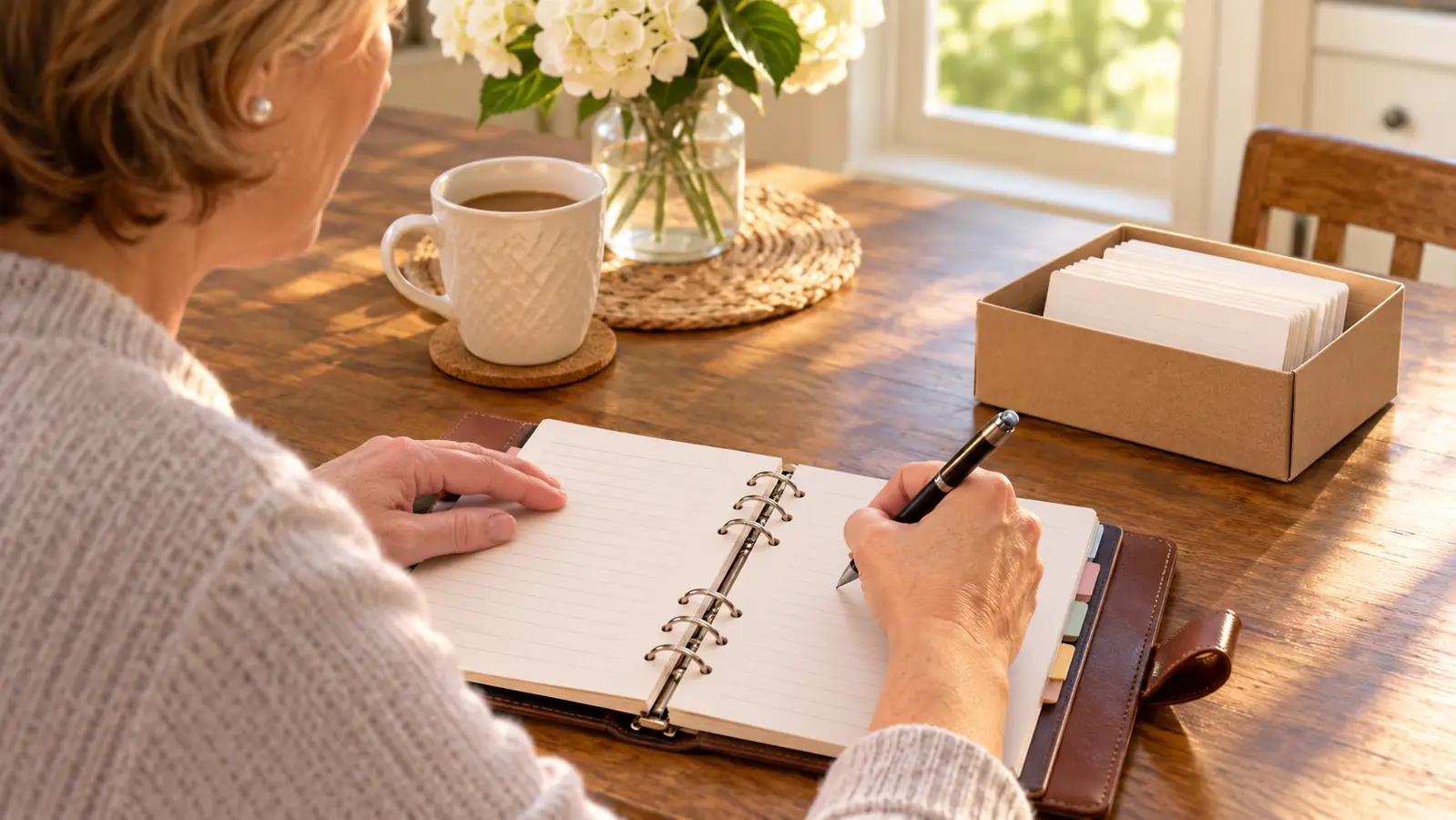
Elise got engaged over Thanksgiving weekend, which gave us roughly six and a half months and no room to drift. The binder arrived the first week of December and I set it at the end of the kitchen table by the fruit bowl, and that is where it lived until June. Not a figure of speech. I opened it most nights, usually after supper, sometimes just to check what I was supposed to be worried about that week.
December and January were the budget pages and the guest list. February was the dress, bought at a bridal shop here in Savannah and sent home in the shop's thin plastic bag. March was the guest book, which Elise chose and I ordered. April was place cards and the disagreement about which table Paul's two brothers would sit at, which we settled that month and never reopened. May was two evenings of handwriting 72 cards in black fine point at that same table. June was the travel.
What the binder actually gave me was a single place to look. On the nights when I could not remember whether we had already settled something, whether it was the deposit or the readings or which cousin was coming with whom, the answer was in one object instead of scattered across my head, a text thread, and Elise's inbox. That sounds like a small thing. Multiply it by a hundred and fifty evenings and it stops being small.
I should say that Paul did nothing with the paperwork. That is not a complaint, it is a description of my household, and I suspect it describes a great many households. If you are the one who ends up holding the pieces, you are the one who needs the binder, and the other person will be perfectly content that you have it.
The Parts That Earned Their Keep
The guest list did more work than anything else in the book. Going from a number to a seating chart that does not insult anybody is the most political work of the entire wedding, and 72 people at 9 round tables of 8 is a puzzle whether you think of it as one or not. Having addresses, replies, and who belongs with whom in one place meant I could sit down with coffee and actually solve it, instead of opening four browser tabs and giving up.
The budget pages were useful in a different way. They do not add anything up for you. I ran every column by hand and checked it twice, which is what thirty years in a school office does to a person. But they force the categories to exist on paper, and it is very easy to tell yourself a thing is just a small extra until you have to write it into a column that already has a total at the bottom.
The questions were the part I would pay for twice. There are decisions in a wedding that you do not know exist until one is standing in front of you, and this puts most of them in front of you in January instead of the last week of May. Not all of them were ours. Enough of them were.
And the notes space matters more than it sounds. Half of what I wrote was not an answer to a printed question. It was a phone number, the name of somebody at the inn, or the sentence I wanted to say to the woman about the flowers. That is the difference between a form and a working book.
What I Liked
- One place for every decision across six and a half months, from the budget columns to the seating chart
- Puts questions in front of you in January that you would otherwise meet in May
- Hardcover, 144 pages, about 2.75 pounds, and it survives a tote bag and an overhead bin
- Real room to write real answers and your own notes, not just boxes to tick
Where It Falls Short
- It asks, it does not remind. Nothing pings you, and if you stop opening it, it stops working
- The budget pages do no arithmetic for you
- It assumes a wedding with more vendors and more events than a small one has, so whole sections went unused
- Bound pages are permanent, so I wrote in pencil from February onward
It never told me what to do. It told me what I had not decided yet, which turned out to be the harder and more useful thing.
What Nobody Warns You About
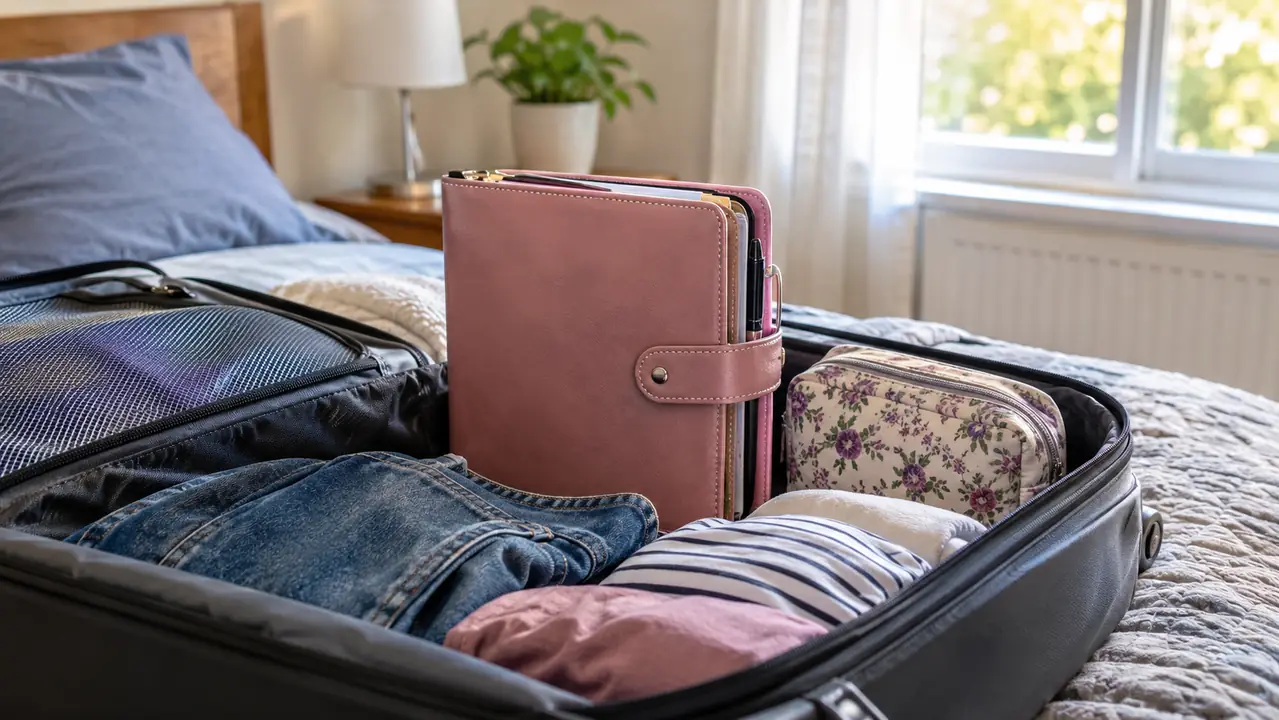
First, the weight, and I mean that literally. At 2.75 pounds and better than 10 inches wide, it is closer to a piece of furniture than to a notebook. It held a real corner of my kitchen table for six months. When we flew out on Wednesday, June 10, Savannah to Albuquerque with a connection in Dallas and then an hour by rental car into Santa Fe, it went into my carry-on and I felt it on my shoulder through every terminal.
Second, it is bound. Some of those pages invite a decision you are going to change three times before spring, and a bound book does not enjoy being edited. I switched to pencil in February. The pages are not designed for pencil, but the wedding was designed for changes, and the wedding won.
Third, and this is the one I would say out loud to a friend, The Knot planner has no memory of its own. There is no alert, no reminder, no little chime. The book will sit there, perfectly organized, while you forget it exists. The only reason this worked for us is that it was on the table I walk past forty times a day. If it had gone into a drawer in December, it would have come out in June with nothing written in it, and I would have blamed the book.
Fourth, it will not call the inn. It will not tell you that a hem is going to come down about forty minutes before a ceremony, which is what happened to Tess, or that you will want a small sewing kit in a bag by the door when it does. That one was mine to think of. I thought of it in May, and the day it mattered I was glad.
The Pages You Will Not Use
I want to be honest about this, because it is the part that makes people feel they wasted money. There are sections in this book built for a bigger wedding than ours. More vendors, more events around the main event, more moving parts. We had an inn, a photographer, flowers, food, and a small band, and that was most of it. Some pages stayed blank and I do not consider that a failure. I consider it the price of a tool that covers everything.
If your guest list is under fifty and the ceremony and the reception happen in the same place, expect to flip past more than you fill in. That is fine. Flip past it and get to the part you need.
What I would say is this: count the pages you filled in, not the pages that exist. If you fill in a third of them and it saves you one bad decision, you came out ahead. If you fill in none, the problem was never the book.
Where It Left Me on My Own
The binder cannot do arithmetic, make a phone call, or sit in a room with two people who want different things. All of that was mine. The arithmetic I did by hand. The phone calls I made from the kitchen with the book open in front of me, which is honestly the best use of it, because every number I needed was on the same two pages.
And it cannot make the decisions for you. It can put a decision in front of you on a Tuesday and leave it there for three weeks, and that is still your three weeks going by. That is the honest limit of any paper system, and it is why the reminder has to be you walking past the table.
What I'd Tell You Before You Buy
Buy The Knot planner early. Not the week you get engaged, but close. The value of this book is in the ordering, and a book that arrives in April for a June wedding is a very expensive scrapbook. Ours arrived in December and I think that was close to ideal.
Buy a pencil and keep it clipped inside the front, and do not be precious about the pages. Write in the margins. Tape things in if you have to. This is a working object, not a keepsake. The keepsake is the guest book your daughter picks out, which is a separate purchase entirely and a much better place to be sentimental.
And do not buy this expecting it to replace a person. It will not chase a vendor or smooth over a family. What it will do is hold the whole thing in one place, so that when somebody asks you a question at four in the afternoon on a Wednesday you can put a hand on the answer in ten seconds instead of promising to get back to them.
Who This Is For
If you are planning a wedding yourself without a full-time planner, over a stretch of months, and you are the sort of person who feels calmer when a thing is written down, this is worth the money. I would buy it again tomorrow for the same wedding, and I would buy it in December again.
It is especially good when one person is carrying most of it, or one person and a reluctant spouse. Elise chose the dress and the guest book. I ran the binder, the place cards, and the day-of bag. That split held together because the binder was in one place and everyone knew where that place was.
It is also good for a mother of the bride who wants to be useful without taking over, which is a narrow road to walk in shoes. I could open a book, see what was still open, and ask a specific question instead of a general one. That is a better way to help than calling to ask how the planning is going.
Who Should Skip It
Skip it if you already have a system that works. If a spreadsheet on your laptop has been open since the engagement and it is serving you, keep it. Paper beats a spreadsheet for me and it does not beat it for everybody.
Skip it if the wedding is very small and very simple, or if you have hired someone to run the whole thing. And skip it if you know in your bones that you will not open it. A planner nobody opens is a 2.75 pound paperweight, and I say that with affection, because I have owned books like that myself.
Six and a half months, one binder, and a seating chart that held
If you are the one holding all the pieces, this is what holds them with you. Hardcover, 144 pages, about 2.75 pounds.
Amazon Check Today's Price on Amazon →