
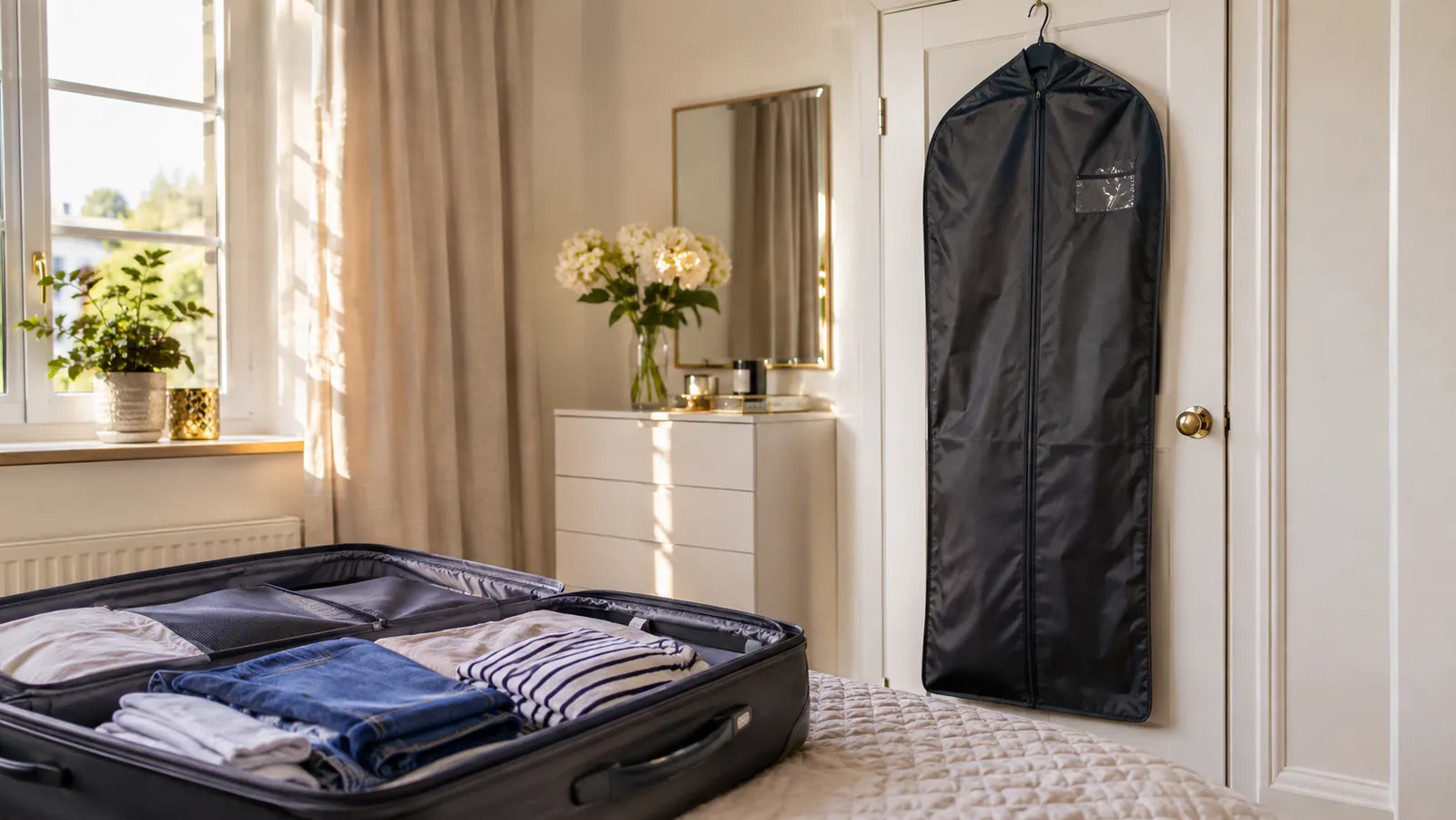
Nobody at the bridal shop tells you what happens after you pay. They put the dress on a hanger, pull a thin plastic bag over it, and send you out onto the sidewalk. That is how my daughter's dress came home to Savannah in February: a soft satin A-line with a short train, inside a bag thin enough to read a magazine through.
We had six and a half months. Elise got engaged Thanksgiving weekend, and the wedding was Saturday, June 13, at a small inn outside Santa Fe. Seventy-two guests, nine round tables of eight, no planner. I ran the binder, the place cards and the day-of bag. She chose the dress and the guest book. What I did not think about until March was the distance between the closet in Savannah and the closet in New Mexico. In April I bought a Sleeping Lamb garment bag, 72 inches long with a 15-inch gusset, a zipper down the front and a clear pouch for a label, and the plastic went out with the recycling.
The folk wisdom I collected from three different people was this: carry it in the bag it came home in and hope. That is not a plan. That is a wish with a hanger on it. Here is ours, in the order I would do it again, though I only have the one daughter and she is married now.
The bag that got a satin dress from Savannah to Santa Fe with one soft fold line
72 inches long, a 15-inch gusset, breathable non-woven fabric and a full-length zipper, with a clear pouch on the front for a name card. It went into the overhead bin on both legs, and it is holding the dress in my hall closet now.
Amazon Check Today's Price on Amazon →Step 1: Retire the shop's plastic bag before you pack anything
The bag a dress comes home in is a courtesy, not luggage. It is thin, it splits at the hanger hole, and it does nothing for a dress that has to survive an airport. Mine got the dress home from the shop, and in April I replaced it with something built to travel.
I wanted three things. Length, so a floor-length dress is not wadded at the bottom. Depth, so the fabric is not pressed flat against itself for hours. And something breathable, so the satin is not sitting in its own stale air. The Sleeping Lamb bag gave me all three: 72 inches from the hanger to the hem, a 15-inch gusset that lets the dress keep some volume, and breathable non-woven fabric instead of the shiny stuff that traps everything. The zipper runs the full length and does not catch. There is a clear pouch on the front, and I put a card in it with Elise's name and my cell number, which only matters if a bag goes missing, and then it matters a great deal.
One honest note: it is not waterproof, and I would not stand in the rain with it. It is a cover, not a case. That was fine for what we needed.
Between April and June that bag hung in the hall closet with the dress inside it, which is exactly where it lives now. It did the storage job for two months before it ever did the travel job, and I like a thing that keeps working after the event it was bought for.
Step 2: Fold the dress once, over a rolled towel
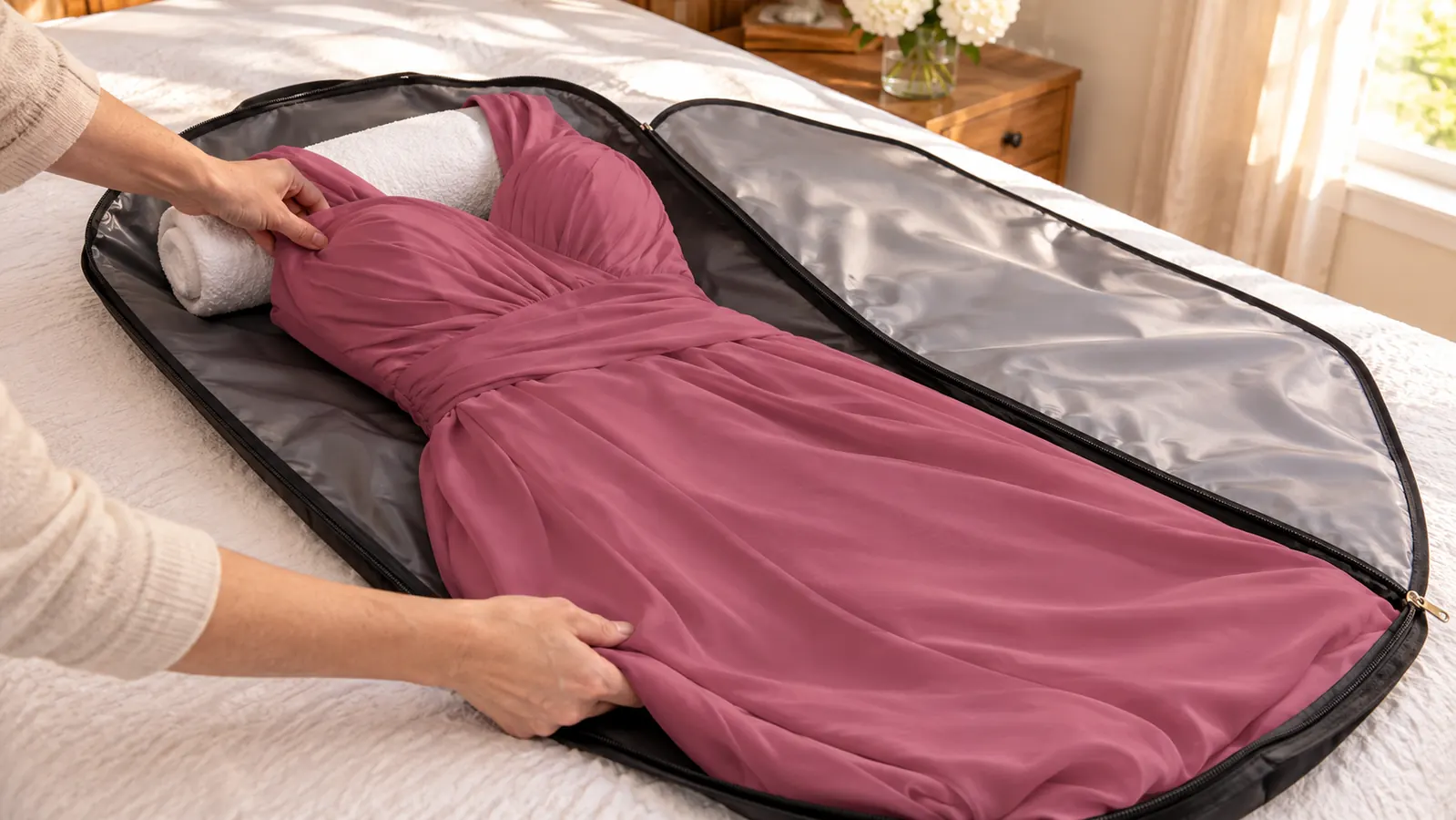
The instinct, when a dress is long and the bag is long, is to fold it in quarters and make it small. That is exactly what puts creases in satin. You want one fold, and you want that fold to be a curve instead of an edge.
I laid the bag open on the bed. Dress on its hanger, laid in flat, then folded once across the skirt over a bath towel rolled tight. The towel does one job: it turns a sharp fold into a soft arc, so the fabric has nothing to crease against on the flight.
Then zip it closed, all the way. One fold, one towel, one zip. Nothing else goes in the bag: no shoes, no jewelry, no little plastic box of pins. A garment bag is not a suitcase, and the moment you treat it like one you have put hard edges against satin for six hours. Ours travelled flat in the car to the airport and flat into the bin.
A word about the hanger. Use the one the shop gave you if it is sturdy. If it is a flimsy wire thing, ask them for something better before you leave the shop, because a weak hanger under a heavy satin skirt will bow inside the bag and pull the shoulders out of shape by the time you land.
Step 3: Carry it on, and keep it with you
We flew Wednesday, June 10, Savannah to Albuquerque with a connection in Dallas, then about an hour in a rental car with Paul driving. The bag was my carry-on on both legs. It went into the overhead bin flat, not standing up, and it stayed there until we landed.
Do not check it. I know a checked bag is easier, and I know the closet at the other end is tempting. A checked dress comes out compressed under forty other bags and, on a bad day, a day late. If a gate agent asks you to check it, take the dress out of the bag and carry it on the hanger instead. I did not have to have that conversation, but I had it planned out in my head, and that counts for something when you are standing in a jet bridge.
The thing that made the airport easier was a second person. Paul walked behind me with the suitcase while I carried the bag folded once over my shoulder, which is how you move something 72 inches long through a security line without dragging it on the floor. He knew what was in it and left the carrying to me.
Rules are different on every airline and every aircraft. Check your own carrier's carry-on limits and current rules before you book, and check them again the week you fly. Nobody writing on a website, including me, can tell you what your flight will allow.
Step 4: Hang it the hour you arrive, and steam it in the bathroom
We got in Wednesday afternoon and the dress went straight into the closet at the inn, on the hanger, inside the bag, and stayed there until Saturday morning. Three days of hanging does more for satin than any tool you can buy.
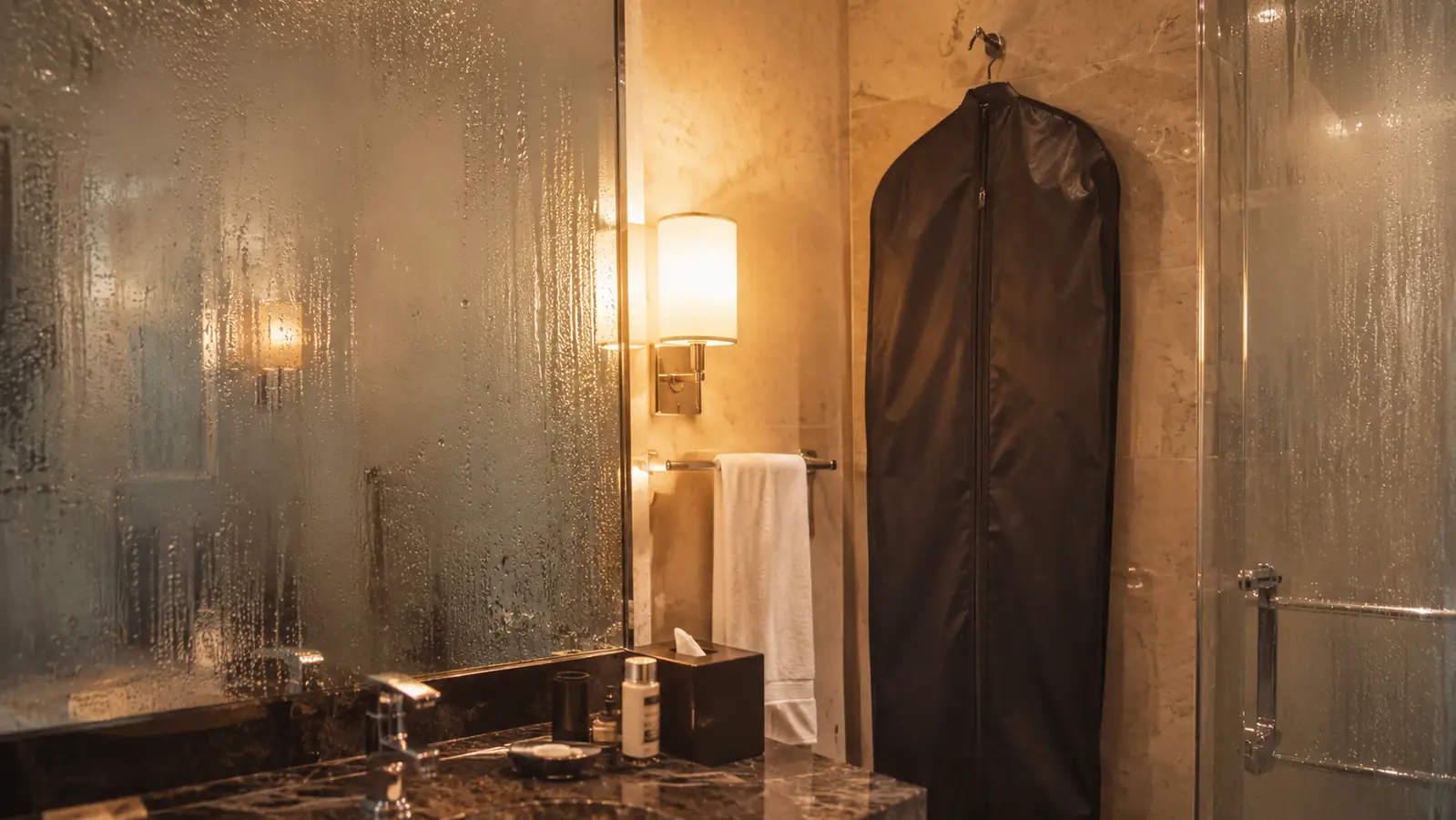
There was one soft fold line across the skirt where the towel had been. Not a crease, a line. Thursday night I ran the shower as hot as it would go, closed the bathroom door, and hung the dress in there for about twenty minutes with the room full of steam. By Friday morning it had relaxed. Saturday morning I could not find the spot unless I knew where to look.
Do not iron it, and do not let housekeeping iron it. If a dress still needs work after three days of hanging and one hot shower, that is a job for a local cleaner, not a travel iron and a bath towel on the back of a door.
After that I left it alone, zipped, in the closet. It was a relief not to fuss with it, and it was one less thing to think about while the week moved at the speed a wedding week moves.
Step 5: Pack the small kit that fixes the thing that actually goes wrong
Forty minutes before the ceremony, Tess's hem came down. Not the dress, the bridesmaid's. It was the only thing that went wrong all day, and it took eleven minutes to fix, because the kit was in the day-of bag and not in a suitcase in a room down the hall.
The kit was a Fiskars 27-piece travel sewing kit, bought in May. Hard orange case, folding stainless steel scissors, a 39-inch measuring tape, thread, hand needles, safety pins, straight pins, buttons and a needle threader. It rode in my carry-on. The listing calls the folding scissors TSA compliant and I had no trouble with them, but check the current rules with your own airline before you count on that. I am not the TSA and neither is a product page.
Two other things travelled with it, and neither one belonged in the garment bag. The place cards, 120 in the pack, gold foil border, tent fold, 3.5 by 2 inches folded, went flat in a shoebox in my suitcase. I had written all 72 guest names on them in black fine-point pen over two evenings at the kitchen table in May, and a bent corner on a place card is a small ugly thing nobody needs. The binder rode in my carry-on, because I am the sort of person who wants the seating chart within reach on a Wednesday.
The day-of bag itself was a canvas tote, not a suitcase, and it stayed with me all day. Everything in it was something we could use in under five minutes without leaving the building. That is the whole test for what goes in and what stays home.
The dress did not need a dress box. It needed one fold, a rolled towel, and a bag deep enough that the satin was not pressed flat for six hours.
What Else Helps
Give yourself a day. We arrived Wednesday for a Saturday wedding, and that buffer is what let the fold line relax on its own schedule instead of mine. If you land Friday night, the bag still works, but you have traded hanging time and a hot shower for a hope.
Decide about a box before you decide about a bag. A dress box is rigid, which is right for a car and wrong for a plane. It does not go in an overhead bin, and it takes up a trunk. I saw one at the bridal shop and left it on the shelf. If you are driving four hours, a box makes sense. If you are flying, it does not.
Do not put the dress in a vacuum bag or wrap it in plastic sheeting to save space. You will save the space and spend the difference on a steamer, and possibly on a cleaner. Fabric that cannot breathe holds whatever it is holding until you open it.
Ask the inn what the closet looks like. I did not ask, and it turned out fine, but a hook on the back of a bathroom door is not a closet, and a rod set low will put a bend in anything floor length. One email in May would have answered it.
Write it down. I put the flight times, the bag dimensions and the name of the inn's front desk on one page in the binder, and then I stopped thinking about it. The week of the wedding is not the week to be reconstructing details from memory.
And keep the bag afterward. The Sleeping Lamb is in my hall closet with the dress in it, which is the least romantic and most useful thing I can tell you. It is still doing a job.
One bag, one fold, one less thing to think about in June
72 inches long, a 15-inch gusset, breathable non-woven fabric, a full-length zipper and a clear pouch for a name card. It carried a satin A-line from Savannah to Santa Fe as a carry-on, and it is holding it still.
Amazon Check Today's Price on Amazon →