
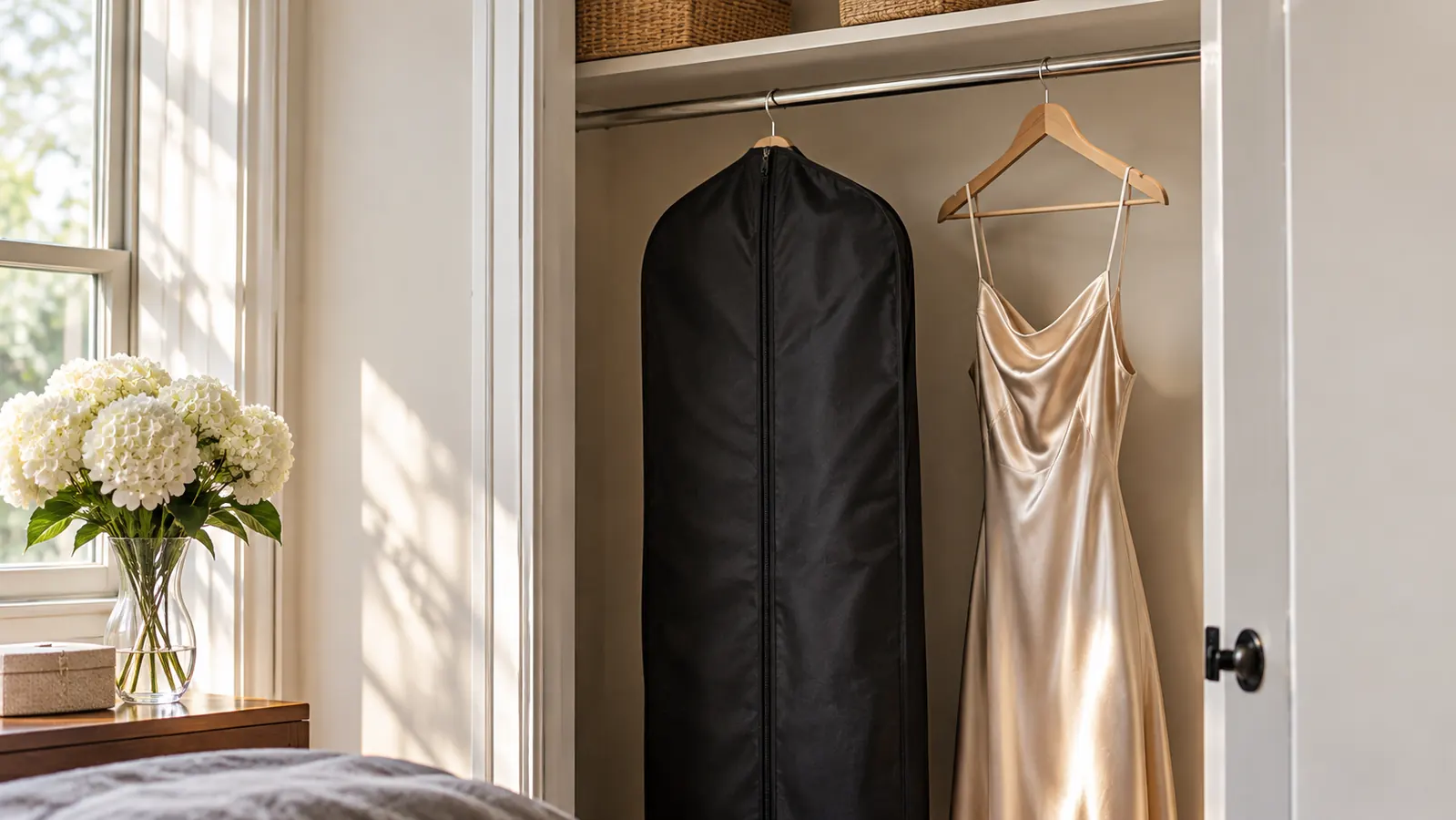
Two ways to move a wedding dress from a bridal shop in Savannah to a small inn outside Santa Fe. One is a long garment bag you fold once and carry on the plane. The other is a rigid dress box that travels on its own terms and meets you there. I used the Sleeping Lamb garment bag for my daughter Elise's dress in June, and I have never owned a dress box. I looked at one on a shelf at the bridal shop in February, and I have read enough listings since to know what a box does that a bag cannot. Here is what I would tell a friend who asked me which one to buy.
Short answer first, because you are planning a wedding and you do not have time for a slow build. If the wedding is somewhere you have to fly to, the bag wins and it is not close. The Sleeping Lamb bag went into the overhead bin on both legs, hung on a rod at the inn from Wednesday to Saturday, and the dress came out with one soft fold line that the steam from a hot shower relaxed by Friday. A dress box wins on two things the bag cannot touch. It takes a hard knock better, and it does not fold the dress at all. If your dress is going to a wedding, buy the bag. If the dress is going into a closet for the next twenty years, that is a different purchase and a box is the right one.
| Sleeping Lamb garment bag | Rigid dress box | |
|---|---|---|
| Getting it on the plane | 72 inches long, folds once over a rolled towel, lies flat in the overhead bin | Rigid and wide, so it ships ahead or rides in a car with the seats down |
| Protection from a hard knock | Fabric and a zipper; a corner slam reaches the dress | Rigid walls and a lid absorb the hit |
| Fold lines | One soft fold at the rolled towel, relaxed with shower steam by Friday | The gown lies flat; nothing to relax |
| Four days in a closet at the inn | Hangs on a rod out of the way, identifiable by the label pouch | Needs a shelf or the top of a wardrobe, lid off |
| Air around the dress | Breathable non-woven fabric, not plastic | A lidded box holds the air it was closed with |
| Checking on the dress | Unzip, look, zip it back up | Lift the lid, move the tissue, close it again |
| Carrying it yourself | One hand, over the shoulder | Two hands and someone to hold the door |
| Labelling | Clear PVC pouch on the outside for a name card | Nothing built in; write on the lid or tie on a tag |
| Storage after the wedding | The dress hangs in a hall closet, folded once | The gown stays flat, out of the light, with tissue at the folds |
| Best for | Flying to the wedding with the dress as a carry-on | Shipping ahead, or keeping the gown for years |
Where Sleeping Lamb Wins
On the plane, which is the whole argument. The bag is 72 inches long and 15 inches deep through the gusset, so a floor-length satin A-line goes in folded once over a rolled towel, and the whole thing lies flat in the bin above your seat. I put it up there myself on the leg out of Savannah and again on the short hop out of Dallas. Nobody at the gate asked me to check it. Nobody measured it or looked at me the way gate agents look at a person carrying a cello. It weighed less than my own carry-on, which Paul ended up dragging through the Albuquerque airport while I carried the dress, and that arrangement suited both of us fine.
At the inn it hung on a closet rod for four days, and that is what the bag is actually for. The fabric is breathable non-woven, not plastic, so the dress was not sealed in its own trapped air in a room where the air conditioning ran all night. The zipper runs the length of the bag and it did not catch once, which sounds like a low bar until you have fought a stubborn zipper at eleven at night with a gown half in and half out. There is a clear PVC pouch on the outside for a label. I put a card in it with Elise's name and my cell number, so anyone at the inn could tell what it was without opening it.
Where a Dress Box Wins
A box takes a hit that a bag passes straight through to the dress. I am not going to be cute about this. Rigid walls, corners and a lid absorb a knock from a cooler sliding in a trunk or a handler setting something heavy on top. Fabric and a zipper do not. If your gown is going by cargo hold, by shipping, or in the back of a truck with the tent and the folding tables, the box is the safer container and I would not argue with anyone who chose it on that basis alone. The dress does not care how the container looks. It cares what happens when something lands on it.
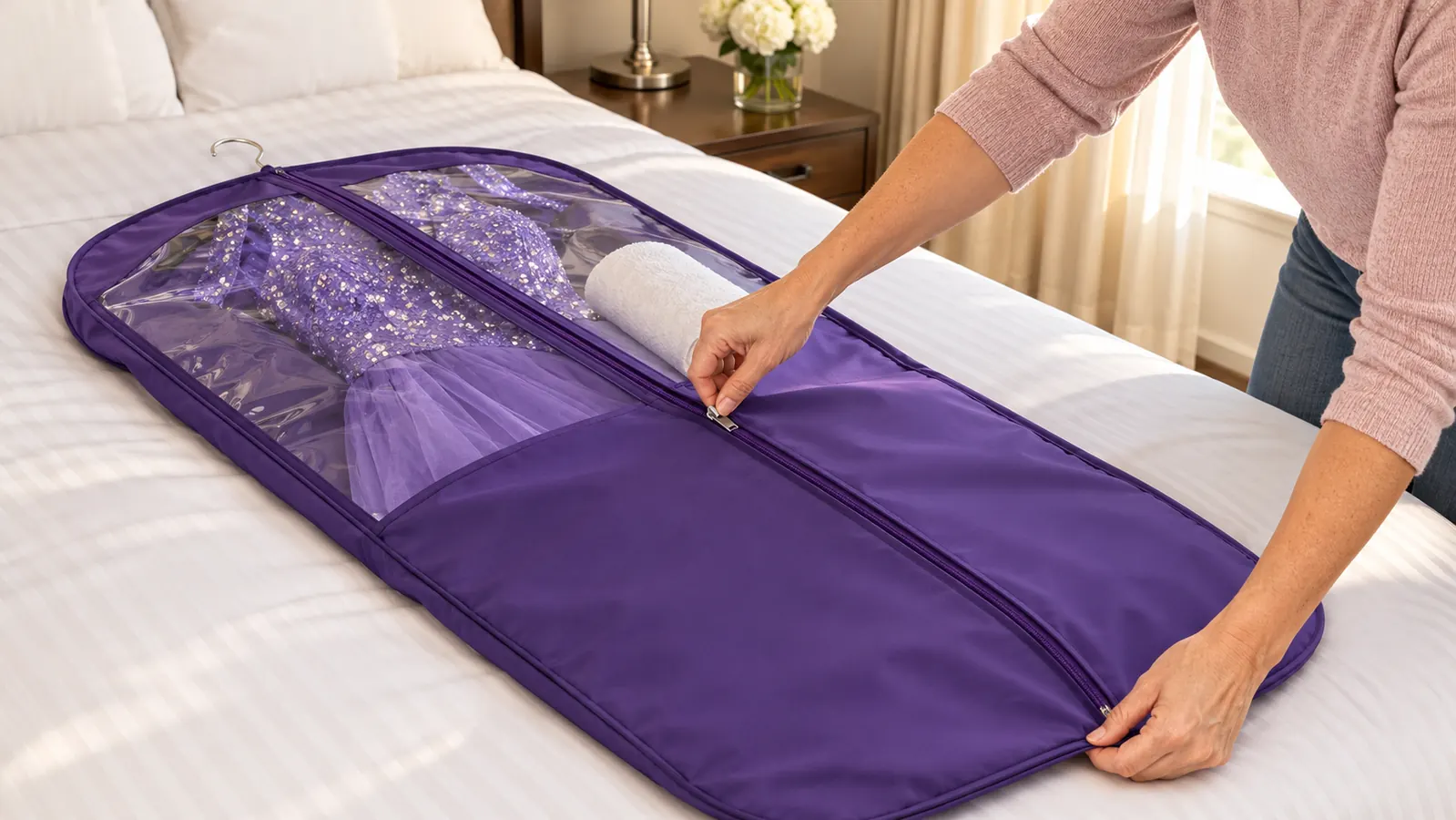
The box also does not fold the dress, and that is the second thing it has over the bag. In a box the gown lies flat or nearly flat, with tissue at the shoulders and the train rolled rather than creased. My bag puts one fold in the dress, at the point where it goes over the rolled towel. Ours relaxed by Friday and the ceremony was Saturday, and I am not going to tell you that always happens. It is a real risk and I accepted it, because a box was not going to fit in the overhead bin and I was not going to hand Elise's dress to a stranger at a check-in counter.
And for the long run, a box is the better home. A dress that will sit in a closet for years wants to be flat, out of the light, with acid-free tissue at the folds, and a lidded box does that with no effort from you. The Sleeping Lamb bag is holding Elise's dress in my hall closet right now and it is doing a reasonable job, but it is a hanging bag with a folded dress inside, not an archival box, and I would not describe it as one to anybody.
The bag that went in the overhead bin twice and came out with one soft fold
72 inches long, a 15-inch gusset, breathable non-woven fabric, a full-length zipper and a clear pouch for a name card. It carried a satin A-line from Savannah to Santa Fe and hung at the inn for four days before the ceremony. Check today's price on Amazon before you settle the bag versus box question for your own dress.
Amazon Check Today's Price on Amazon →What the Sleeping Lamb Bag Actually Is
Strip away the wedding and it is a long cover with a zipper. Seventy-two inches tall, 24 inches wide, 15 inches through the gusset, in a breathable non-woven fabric that is not plastic and should not be treated as waterproof. Full-length zipper. A clear PVC pouch on the outside for a name card or a label. That is the entire object, and I mean that as a compliment. It has 4,195 reviews on Amazon and a 4.7 average, which is the kind of number that tells you it does the basic job for a lot of people without telling you a single thing about your dress in particular.
Where it earns its place in a wedding is the gusset. Fifteen inches of depth means the dress folds rather than compresses. A flat garment bag forces a satin A-line into a sandwich; this one gives it room to sit in a single soft fold over a rolled towel, and the towel keeps that fold from turning into a hard line across the front of the skirt. I bought it in April, two months after the dress came home from the shop in a thin plastic bag I did not trust to survive a car ride across town, let alone two flights and a rental car. That plastic bag is what the shop sends everyone home with. It is not a travel container and nobody behind the counter pretends it is.
What a Dress Box Actually Is
I need to be plain about this one. I did not own it. I saw one on a shelf at the bridal shop in February, a wide flat box with a lid, and I have read listings for the archival versions since. What they are is rigid. Corrugated or acid-free board, sized to the gown folded flat with tissue, sometimes with a window in the lid and more often with nothing on it but a blank space for a name. They are sold for keeping a dress, and the travel versions are sold for moving one.
What a box does not have is a hanger, a shoulder strap, or any way to live in an overhead bin. It is a container you carry with two hands, or ship, or lay in the back of a car with the seats down. For a wedding across the country, that means it goes ahead of you, with somebody you trust, and you hope the person meeting you there knows to put it somewhere flat and off the floor. That is a chain of people, and a chain of people is where things go sideways. I did not want to add a gown to that list.
The Trip, in Detail
We flew out Wednesday, June 10, Savannah to Albuquerque with one connection in Dallas, then about an hour by rental car up to Santa Fe. Home Monday, June 15. The dress was folded once over a rolled towel, laid in the bag, zipped, and carried on both legs. I did not check it and I would not. Airline rules on what counts as a carry-on vary, so check with your own airline before you fly, because the last thing you need is an argument at a gate with a dress in your arms and no plan B.
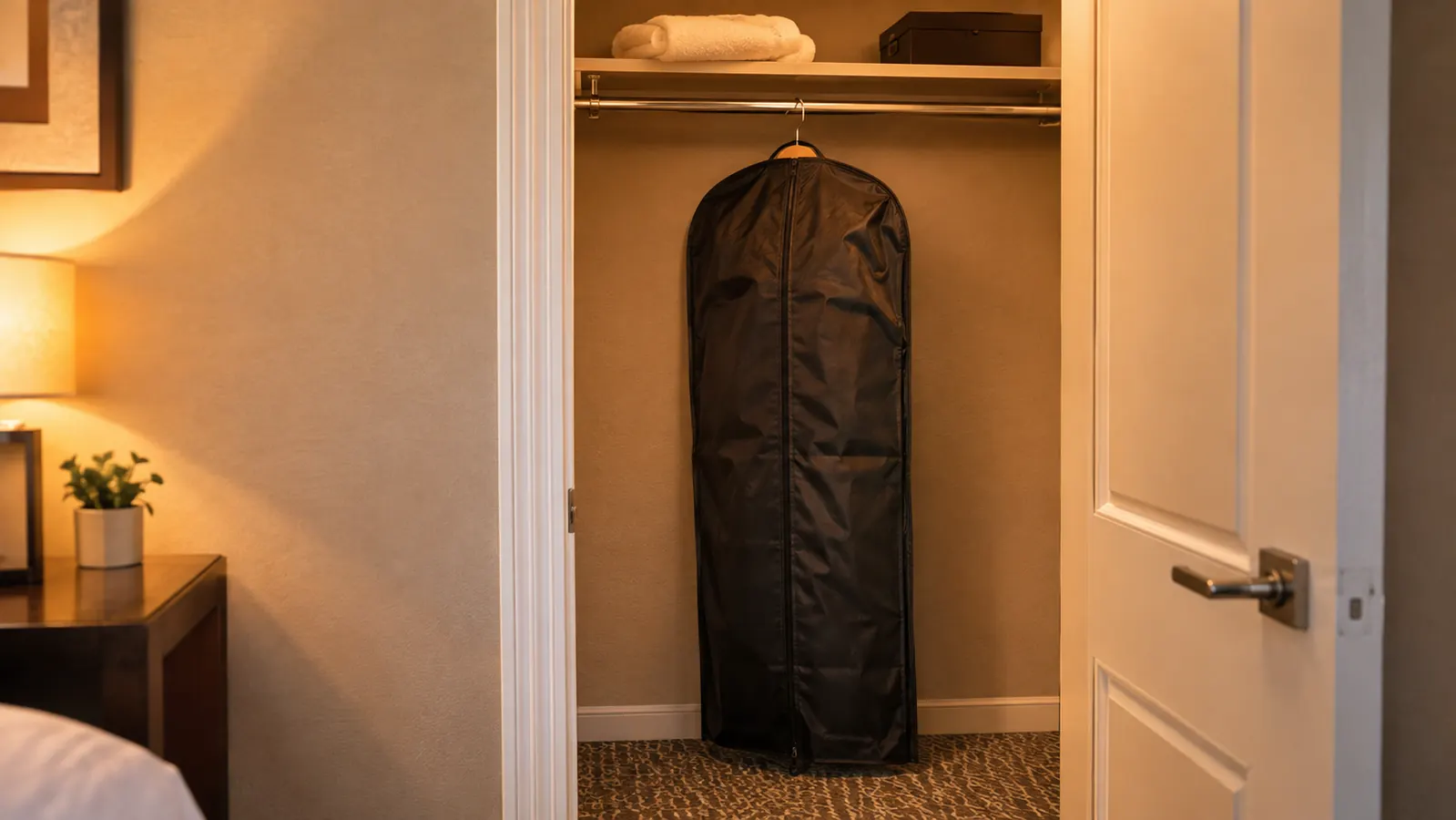
At the inn the bag went straight to the closet and hung there from Wednesday afternoon until Saturday morning. It came out Thursday night for the steam from a hot shower and Saturday to be put on. For the trip home it went back in the same way, folded once over the same towel, zipper closed. It is back in my hall closet now with the dress inside it, which is more than I can say for the plastic bag from the shop.
Twenty minutes of hot shower steam in a closed bathroom did what no amount of shaking out was going to do. By Friday the fold was gone and the ceremony was Saturday.
The Fold Line, and How It Came Out
There was a fold line across the front of the skirt when I unzipped the bag at the inn on Thursday night. One line, soft, not a crease. Nobody panicked. I hung the dress in the bathroom, shut the door with the window closed, and ran the shower hot for about twenty minutes. By Friday it was gone.
That is the honest version, and it comes with a condition attached. Steam works beautifully on a soft satin A-line. It works less well on heavy beading, on a structured bodice, or on any fabric that likes to hold a crease. If your dress is one of those, a container that never folds it is worth the trouble even if it complicates your travel. Ask the shop. Ask before you buy either one, and ask about your specific fabric, because that is the question that actually decides this for you.
What I Would Do Differently
Two changes, neither of them a disaster. I would have bought the bag in February, the week the dress came home, instead of waiting until April, because the plastic bag the shop hands you is meant for a car ride across town and nothing more. And I would have written the name card the day I bought the bag, not the night I packed. If I had chosen a box instead, I would have shipped it to the inn a week early and confirmed by phone that a specific person would set it down flat in a closet rather than somewhere in the back.
Who Should Buy Which
Buy the Sleeping Lamb bag if you are flying to the wedding, if you want the dress in the cabin with you instead of in a cargo hold, and if the fabric will let go of a single soft fold with a little steam. That was our situation and it worked. Buy a dress box if the gown is travelling by car or by shipping, if it is heavy or beaded or holds a crease, or if this is the container that will hold it for the next twenty years. If you can manage both, a bag for the trip and a box for the years after, that is what the bridal shops do and it is not a bad plan.
The one thing I would not do is choose based on which container looks more like a wedding. A box looks like an heirloom. A bag looks like luggage. On the day itself, luggage is what you need, and nobody at the ceremony is going to ask what the dress arrived in.
If you are flying to the wedding, this is the container that goes in the cabin with you
Long enough for a floor-length gown, deep enough that the dress folds once instead of compressing, and labelled so you can find it in a shared closet. It carried one satin A-line on one round trip and now holds it at home.
Amazon Check Today's Price on Amazon →