
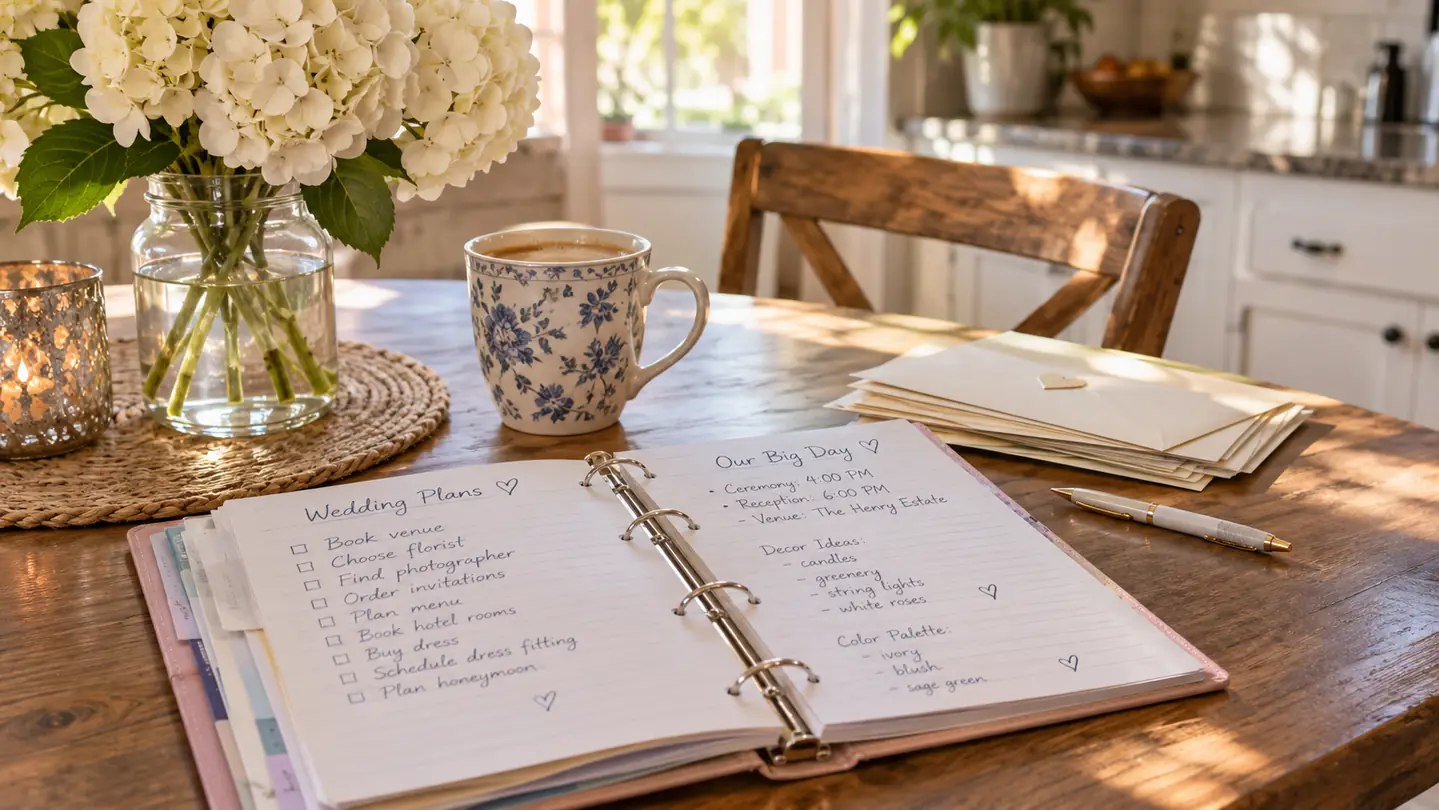
Elise got engaged on the Saturday of Thanksgiving weekend, and by the following Tuesday she had a date in her head. Not June in two years. June in six and a half months. I have planned exactly one wedding in my life and it was that one. I am not a professional planner and I have never pretended to be. What I am is a retired school office manager in Savannah who kept a main office running for a living, which means I know how to hold a calendar, a filing system and a stack of paperwork together without letting any of it swallow the year.
The first thing I bought, in the first week of December, was The Knot Wedding Planner and Organizer. It is a hardcover binder, 144 pages, 2.75 pounds, about 10.42 by 11.84 inches and 1.8 inches thick. What it is, plainly, is a set of pages to fill in, section by section, with room for notes on the things the printed page did not think of. Nothing in it plans the wedding for you. What it does is stop the wedding from living in six different places at once. Before it, we had a spreadsheet Elise started on her laptop and dropped after two weeks, a group text with more messages about napkin colors than about the ceremony, and me repeating dates out loud to Paul so I would not forget them.
One binder, 144 pages, and no more repeating dates out loud to your husband
Every list, every budget page and every vendor phone number in one place, with margins wide enough for what the printed page forgot. 2.75 pounds of it went in my carry-on and came home with me.
Amazon Check today's price on Amazon →The Five Steps That Ordered Our Six Months
Step 1: Put the binder on the kitchen table before you book a single thing
Before you tour a venue, before you make one call, sit down and fill in the only two things you can fill in without knowing anything: the date you want and the names of the people who have to be in the room. That sounds thin. It is not thin at all, because those two pages decide nearly everything downstream of them. I wrote June 13 with a line under it, and I wrote July in the margin with a line through it, because Santa Fe in July is a different wedding and Elise had opinions about the heat.
Writing the no down mattered more than I expected. When a vendor asked about other dates that winter, I could open the binder, look at my own handwriting and decline without relitigating a decision we had already made in December. A page you filled in yourself is harder to argue with than a text thread.
The other thing I did that first week was write my name and phone number inside the front cover. Not because I am precious about my belongings, but because that binder went to a venue, a florist and a bakery in a tote bag, and I wanted it to come back to me. It did.
What surprised me is how quickly the binder replaced everything else. The spreadsheet died because Elise could not carry it into a bakery and neither could I. The binder came with us. By February, any question anyone asked about the wedding got the same answer from me: let me look, it is in the book.
Step 2: Count the guest list before you count chairs
Elise's list, Ben's list, and the list Paul and I made of people who would notice if they were not invited. Three lists, one section, and a number at the bottom of it. Ours came to 72 people, which is nine round tables of eight. I know that because the guest list pages made me count them before we signed a venue contract, not after.
That number did more work than any conversation we had. We toured one room that sat 90 and one that sat 60, and 72 made the decision in about four minutes. If we had guessed, we would have signed for the prettier room and spent six months quietly cutting cousins.
Leave room to change the names. People get engaged, other people get divorced, addresses change. I worked in pencil from February, and the seating went in only in April, once the number was real. That was the one disagreement of the whole engagement: Paul's two brothers at the same table, or at two tables across the room from each other. We settled it in April. Both of them at table four, the table nearest the door, so either one could step out for air without a scene. It stayed settled because the page said so and neither of them wanted to be the man who argued with a seating chart.
Step 3: Fill in the money pages before you fall in love with a venue
This is the step most people do backward. They find the room, then find the money. The budget section of the binder asks you to set the whole figure first and then give every category a share of it, which is a far less enjoyable afternoon and a far better use of one. We did ours at the kitchen table between Christmas and New Year, with coffee, a calculator and a certain amount of sighing.
The part I did not expect to lean on as hard as I did was the vendor pages in The Knot binder. There is a place for the deposit, the date the balance comes due and the name of the person you actually spoke to, which is almost never the name on the website. I wrote down the person every single time. When a question came up in May about the chairs, I called that person instead of the general number and had an answer in one call.
Here is the unglamorous truth about those pages. They are the reason I did not miss a final payment in May. Not because I am an organized person by nature. Because the date lived in a book on the kitchen table instead of in an email I had already read and forgotten.
Seventy-two people, nine tables of eight. The guest list pages made me count them before we signed a venue contract, not after.
Step 4: Work the timeline backward from the date, not forward from today
Six and a half months sounds like plenty in December and sounds like a joke in April. The only way I found to keep it honest was to start at June 13 and walk backward one page at a time. Dress in February, so it was settled early. Invitations out in early April, because people need time to book a flight and find a sitter. Place cards in May, because 72 names take two evenings and no more than that. Each of those went into the timeline pages as a date, not as an intention.
What filled in around those fixed points were the small deadlines I would otherwise have dropped: the tasting, the final headcount, the call to confirm the rental car, and the Tuesday afternoon I sat down and wrote out the whole schedule for the day itself. By the time we got on a plane it was the single most useful thing in the book.
I also wrote every vendor phone number by hand in the back, in one place. Not in my phone. My phone was with me the whole time and so was the binder, and only one of those two things runs out of battery in a rental car in the dark.
Step 5: Move everything into the day-of pages and carry them with you
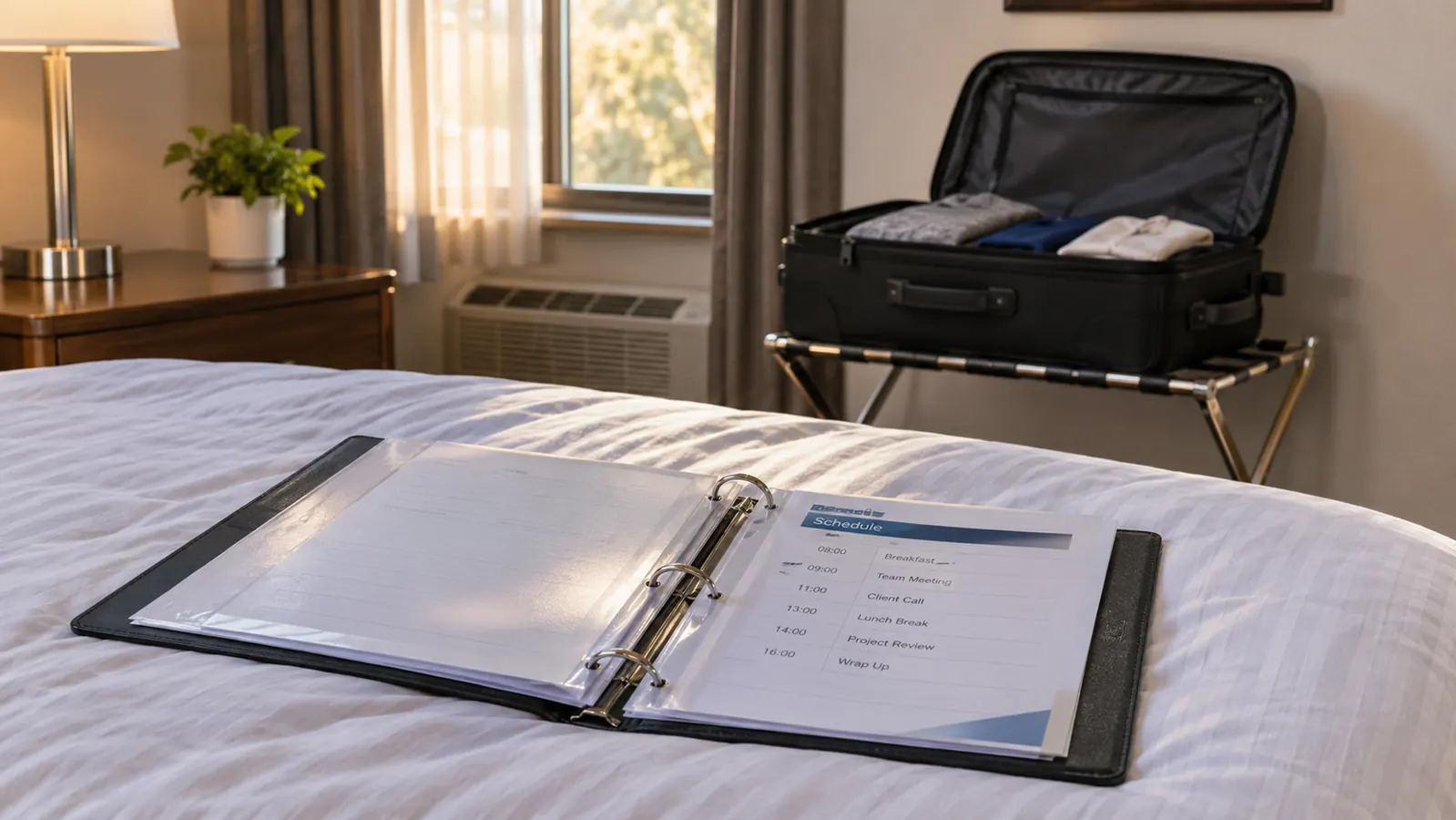
Two weeks out, I stopped adding to the binder and started pulling from it: the schedule, who was carrying what, and the phone numbers that needed to be reachable at any hour. That is what I worked from, and the binder came with me.
We flew out on Wednesday, June 10, Savannah to Albuquerque with one connection in Dallas, then about an hour by rental car to Santa Fe. The binder went in my carry-on. At 2.75 pounds it does not fit in a seat pocket, which is fine, because it fit under the seat in front of me and came out at the connection when I needed to check a name. We were home Monday, June 15.
I am firm about carrying it rather than packing it in a checked bag, and the reason is simple. Everything that could not be redone was written in that book, and a checked bag that does not arrive takes the schedule with it. The dress had its own arrangement. The paperwork stayed with me.
The day-of bag itself was small: a sewing kit and a little pouch of wipes and blotting papers I put together myself. That was all of it. Every wedding website I read wanted me to bring thirty items, and the only thing I reached for was the sewing kit.

What Else Helps
The binder ran the plan. Four other things got us through the week, and I would buy all four again.
The dress came home from the Savannah bridal shop in February in the shop's thin plastic bag, and I did not trust that bag on a plane. In April I bought a Sleeping Lamb garment bag: 72 inches long, a 15-inch gusset, breathable non-woven fabric, a zipper down the front and a clear pouch on the outside for a label. We folded the dress once over a rolled towel, laid it in the bag and put it in the overhead bin on both legs. It hung in the closet at the inn from Wednesday to Saturday. It arrived with one soft fold line, and the steam from a hot shower in a closed bathroom relaxed it by Friday. It is not waterproof and I would not pretend otherwise. It holds the dress in my hall closet now.
The Fiskars 27-Piece Travel Sewing Kit came in May for the day-of bag: a hard case, folding stainless steel scissors, a 39-inch measuring tape, threads, hand needles, safety pins, straight pins, buttons and a needle threader. I sew basic hems and nothing more. Tess's hem came down about 40 minutes before the ceremony and that kit fixed it. The listing calls the folding scissors TSA compliant; I would still check the current rules with your own airline before you pack it.
The Toncoo place cards were the last thing I finished and the thing guests mentioned most. 120 cards in the pack, gold foil border, tent fold, 3.5 by 2 inches folded. I used 72 of them and hand-lettered every one in black fine-point pen over two evenings at the kitchen table in May. The leftovers labelled the dessert table. The rest are still in the pack in the hall closet. They travelled flat in a shoebox in my suitcase and not one of them bent.
Elise picked the guest book and I ordered it in March: beige linen cover, gold foil lettering, 50 blank sheets, 9 by 7 inches, with spaces for instant photos. We put it on a small table by the reception door with a camera borrowed from Ben's sister, and guests took a picture and wrote beside it. It lives on their coffee table now, and they read it out loud to me when I visit.
If you buy one thing off this list, buy The Knot binder first and buy it before you book anything. The rest can wait until you know what you are actually planning.
What I Would Do Differently
I would do the money pages and the guest list in the same first week again. Everything else in the binder leans on those two, and having both settled early is what kept the rest of the planning calm.
I would also stop reading wedding checklists online. Every one of them was written for a two-year engagement with a coordinator, and every one of them made me feel behind in January for something that did not matter until May. The binder had its own sequence, worked backward from our real date, and it was right about the order more often than the internet was.
The book that came home with us, and the first thing I would buy again
144 pages, hardcover, 2.75 pounds. Fill it in at the kitchen table in December and it will still be answering questions for you in June.
Amazon Check today's price on Amazon →