
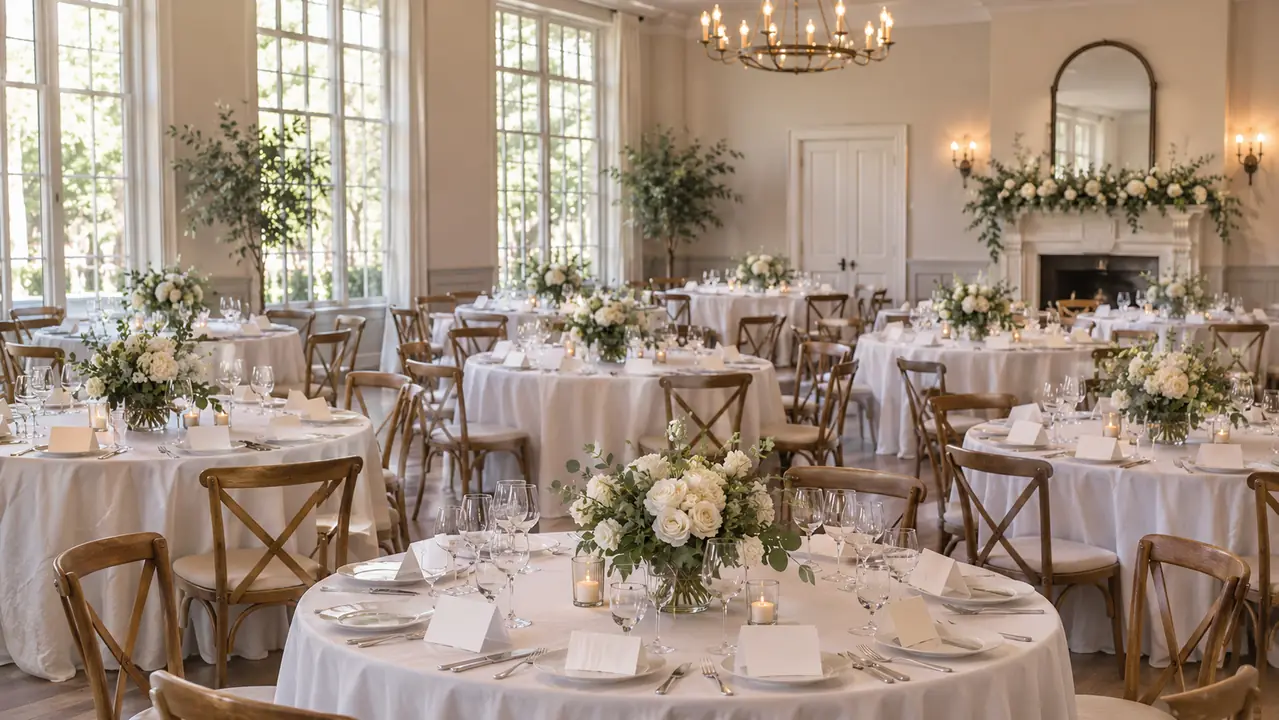
The first thing nobody tells you about place cards is that the wedding is not the hard part. The hard part is the kitchen table in May, a stack of cards that all look identical, and a guest list you have to get exactly right. I bought the Toncoo 120-piece set in April for my daughter Elise's wedding. I wrote 72 names on those cards over two evenings with a black fine-point pen, a handful of the spares labelled the dessert table, and the rest stayed in the pack in the hall closet. That is the short version. The longer version is about paper, handwriting, table space, and the small arithmetic problem of buying 120 cards for 72 guests.
Elise and Ben were married on Saturday, June 13, at a small inn outside Santa Fe, New Mexico. Seventy-two guests, nine round tables of eight, no paid planner. I ran the binder, the place cards and the day-of bag. The Toncoo cards were one of the few things in those six and a half months that behaved exactly the way I expected. This is not a review that will tell you they changed my life. It is a review that will tell you what the listing leaves out: where the cards are easy, where they are not, and who should buy a different kind of card entirely.
The Quick Verdict
A reliable tent card for a handwritten wedding, as long as you start early, keep long names short, and accept that 120 is more than a small guest list needs.
Amazon Check Today's Price →Count the guest list before you count the cards.
Toncoo gives you 120 tent cards, 3.5 by 2 inches folded, with a gold foil border. For 72 guests that leaves room for the dessert table and a few spares. Check the current listing before you commit.
Amazon Check today's price on Amazon →How I've Used It
I bought the Toncoo set in April, two months out. The pack held 120 cards. I used 72 for guests, a handful for the dessert table, and the rest stayed in the pack. The cards travelled flat in a shoebox inside my suitcase. We flew Wednesday, June 10, Savannah to Albuquerque with one connection in Dallas, then about an hour by rental car to Santa Fe. The cards arrived flat and stayed flat. They did not travel in the carry-on with the dress. They travelled with my shoes, which is where a paper product belongs if you want it to come out the other side uncreased.
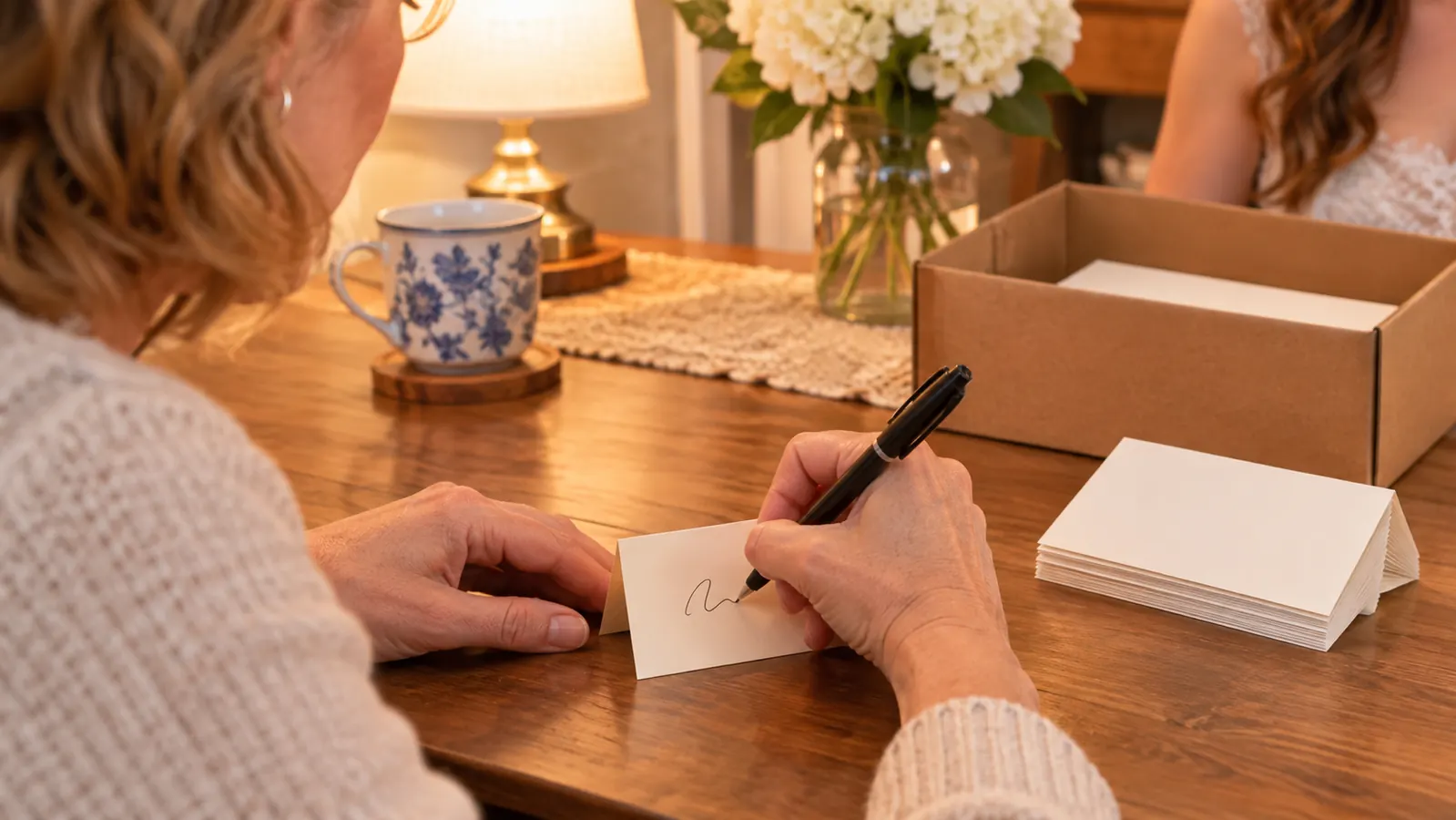
I wrote them at the kitchen table in May, two evenings, black fine-point pen. I am not a calligrapher. My handwriting is the handwriting of a woman who ran a school office for 30 years: legible, upright, and a little tired by the second dozen. The cards made the result look better than my hand deserved. I wrote one table at a time, in seating order. I used the fold as a center line and the gold border as an edge. By card 12 I had a method. By card 60 my hand was sore and the method was carrying me.
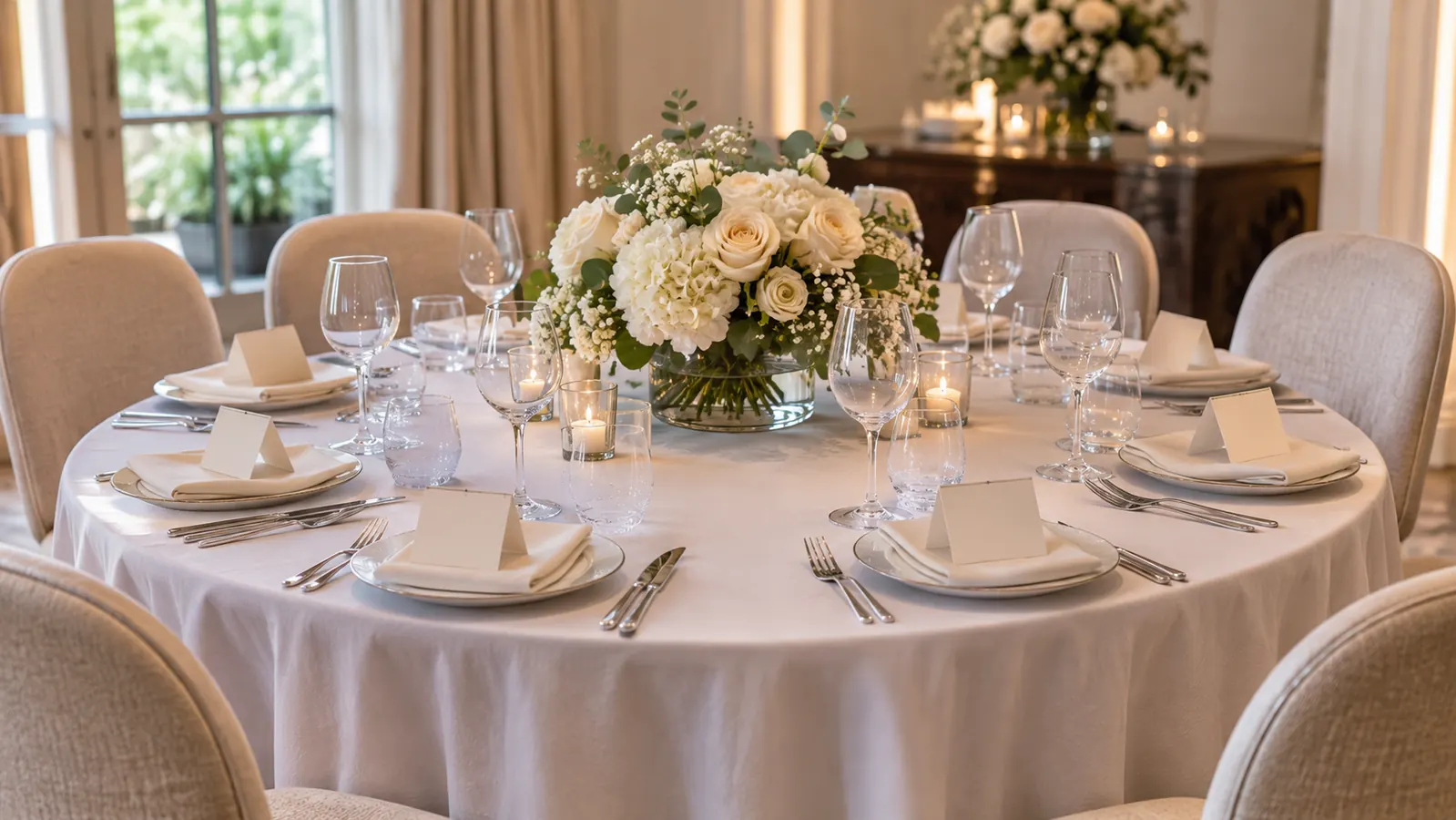
At the inn I set them out on the napkins before the ceremony. The tent fold meant no holders, no little stands, no tape, no improvised weight from a butter knife. I did not think about them again until I cleared tables. That is the highest compliment I can pay a piece of wedding paper. It never became a task on the day.
What the Listing Gets Right, and What It Leaves Out
The listing says 120 pieces, gold foil border, 3.5 by 2 inches folded, 3.5 by 4 inches unfolded, paper. That is accurate, and the numbers are the ones that matter. The card folds in half and stands on its own. The gold foil border is a printed frame, not a stamped edge, and it catches light without looking like a craft project. The pack weighs 0.26 kg. If you have been picturing letterpress, this will feel thinner in your hand than what you have been imagining. It is a working card, not a heavy one.
The unfolded size is 3.5 by 4 inches and the folded size is 3.5 by 2 inches. That matters more than it sounds, because 2 inches of height is what you write inside. A first and last name fits comfortably. A long hyphenated name plus a table number does not fit on one line unless you write small. I wrote first and last for most guests and first names only for the children. Nobody said a word. If your list is heavy with formal names, hold the card in your hand before you order 120 of them.
The listing does not give a paper weight, and I am not going to invent one. What I can tell you is what happened with my pen. I tested one card before I wrote a name on the real stack. Black fine-point went down clean, no feathering at the edges, no bleed through to the back of the tent. I did not try a marker, a fountain pen or a gel pen. If you plan to write with something wet, test it on a card you were going to use for the dessert table anyway. That is a five-minute errand that saves a second evening.
The Writing Part Nobody Warns You About
Nobody warns you that place cards are a handwriting project, not a stationery purchase. You are buying 120 chances to misspell a name in front of people who have known that family for forty years. I wrote 72. I did it over two evenings after supper, guest list on my left, stack on my right. Paul watched the news. I did not let him help. He would have written too large, and I do not start over on paper.
The card size forces a decision. Write large and fill the card and it looks confident, but then there is no room for a table number without crowding the border. Write small and neat and it looks like a school office wrote it, because one did. I chose small and neat. The gold border gave me an edge to line up against and the fold gave me a center line. I did not read that anywhere. I figured it out by card 12. If you have 200 guests, this is not a two-evening job. If you have 72, as we did, it is two.
I wrote tables one through five the first night and the rest the second. I kept the guest list in the same order as the seating chart so I could check a table number without flipping pages. One table at a time, checked against the binder. That was the whole system. The cards did not make the writing easier. They made the finished result look tidy, and tidy is what a guest sees from across the room.
What I Liked
- 120 cards in one pack, enough for 72 guests plus a dessert table
- Tent fold stands without holders, stands or tape
- Gold foil border gives a finished look without extra decoration
- Consistent 3.5 by 2 inch folded size, easy to stack and pack flat
- Takes black fine-point pen cleanly in my experience
Where It Falls Short
- Paper, not heavy cardstock, so it will not feel like letterpress
- The 2 inch height leaves little room for long names and table numbers
- You have to hand-write every card yourself
- 120 is more than a small wedding needs, so you will store leftovers
- It is a working card, not a keepsake anyone will frame
Seventy-two names, two evenings at the kitchen table, one shoebox in a suitcase. The cards asked nothing of me at the inn, and that was the point.
How They Held Up on the Table
The tent fold is the whole mechanism. There is no stand, no clip, no easel. You fold the card, you stand it up, and it holds. I set ours on the napkins at each place setting, eight to a round table, nine tables. The cards stood through the ceremony, dinner and three toasts. I did not rescue one and I did not see one flat on the cloth. That is what I wanted from a place card. I did not want a craft project in the middle of the table. I wanted a name a guest could find without asking.
They are paper, and paper has a temperament. I would not park one beside a sweating water glass and expect it to stay crisp all evening. Ours sat on napkins, inside the glass line, and they were fine. If your venue sets a crowded table with chargers, favors and three glasses, think about where the card goes before the day. A tent card needs a flat spot and a little air behind it. On a tight table it will be the first thing a guest moves, and that is the table plan's fault, not the card's.
The gold foil border did what I wanted it to do, which was to make a plain card look deliberate. Under the inn's lamps it read warm rather than bright. In the daylight from the tall windows it was softer. I am not going to tell you it looks engraved, because it does not. It looks like a good printed card with a gold frame, which is what it is. If you want guests to pick it up and ask where it was done, this is not that card. If you want a napkin to look finished, it is.
What About Escort Cards and Printed Names
Several people have asked me why I did not use escort cards, the little cards laid out alphabetically on a table by the door, so a guest finds a name and then finds a seat. The honest answer is that I never used them and did not want to learn a new system in April. Escort cards do a different job: they tell a guest which table, and then the guest takes the card along. Place cards sit at the place and tell a guest which chair. We had nine tables of eight and a seating chart in the binder, so a card at the place was enough. If you are choosing between the two, the question is whether your guests need direction at the door or at the seat.
The other question I get is whether to print the names instead of writing them. Printing is faster and it is uniform. Writing is slower and it is not uniform, and on the day it looks like a person did it. I am biased. I wrote all 72 by hand because two evenings at the kitchen table felt like part of the job. If your handwriting is a source of stress rather than a small pleasure, print them. There is no prize for a sore hand, and no guest has ever inspected a place card looking for proof of effort.
The Leftovers and the Dessert Table
The pack has 120 cards. We had 72 guests. That left 48. I used a handful for the dessert table, writing cake, pie and coffee in the same black pen, and the rest went back into the pack and into the hall closet. They are on a shelf in the hall closet now. I do not know what I will do with them. I am not a woman who needs 40 place cards in reserve, but I am also not one to throw away a useful thing. They will be there if Elise has a shower or a dinner that needs names on it.
If you are planning a smaller wedding, 120 is more than you need. That is arithmetic, not a complaint. A 40-guest wedding uses 40 cards and leaves 80. You will use them for a shower, a birthday, a supper club, or you will store them beside the good scissors. The extra cards did not add to my writing, only to the stash. Buy the pack for the count you actually need and treat the remainder as a bonus, not as a reason to invite more people than your budget allows.
The leftovers also gave me a cushion I did not need. I had never bought place cards before and had no idea how many I would ruin. I ruined none. That is not because I am careful. It is because the card takes pen cleanly and the fold gives you a line to work against. If you are the kind of person who lies awake worrying about starting over, the spares are a quiet comfort. You will use three of them on the dessert table, put the rest away, and sleep fine.
What I Would Do Differently
I would buy the same Toncoo cards again. I would not chase a heavier stock, because heavier paper would not have improved my handwriting and it would have lightened my wallet for no gain. I would start one week earlier. Two evenings was enough, but it was enough the way a school deadline is enough. I would also write the table numbers on a sheet of paper first, so the seating chart check happened once instead of three times. That is not the card's fault. That is my kitchen table being a kitchen table.
I would hand the cards to a helper at the inn. I did them myself before the ceremony and it worked, but I was doing them while also thinking about the dress and the rings. The cards took twenty minutes. Twenty minutes is not a crisis. It is twenty minutes I would rather have spent sitting down with a glass of something cold. If you have a day-of helper, hand them the box and the seating chart. If you do not, do it before you get dressed.
Who This Is For
Toncoo place cards are for the bride, groom or mother of the bride who is writing the names by hand and wants a card that stands up without hardware. They are for a seated dinner with a table plan and a guest list that is not 300 people. They are for someone who would rather put the money into flowers than into engraving. They are also for the person who wants a card with a gold border that does not look like it came out of an office supply closet. If you are writing 72 names over two evenings, this is a sensible pack, and the count gives you room to be wrong.
They suit the planner working without a planner. I had a binder, a spreadsheet Elise dropped after two weeks, and a kitchen table. That was the operation. The Toncoo cards fit into that kind of planning because they do not require a printer, a design file or a calligrapher. They require a pen and a list. When you are six and a half months into planning and every other decision comes with a deposit attached, a purchase that asks only for handwriting is a relief. That is not a small thing. It is most of the reason I am still fond of them.
Who Should Skip It
Skip these if you want a heavy, textured card with a letterpress impression. Skip them if a calligrapher is doing the writing and needs more room than 3.5 by 2 inches folded gives. Skip them if you have 200 guests and no help, unless you are prepared to start writing in March. Skip them if you want the card to double as a menu, a favor tag or a keepsake people take home. This is a place card. It does one job well and it will not take on a second one because you would like it to.
Write the names early. The cards will do the rest.
The Toncoo set is a straightforward tent card with a gold foil border, 120 to a pack, 3.5 by 2 inches folded. If that is the job you need done, check the current listing and count the guest list twice before you pick up the pen.
Amazon See the Toncoo place cards on Amazon →