
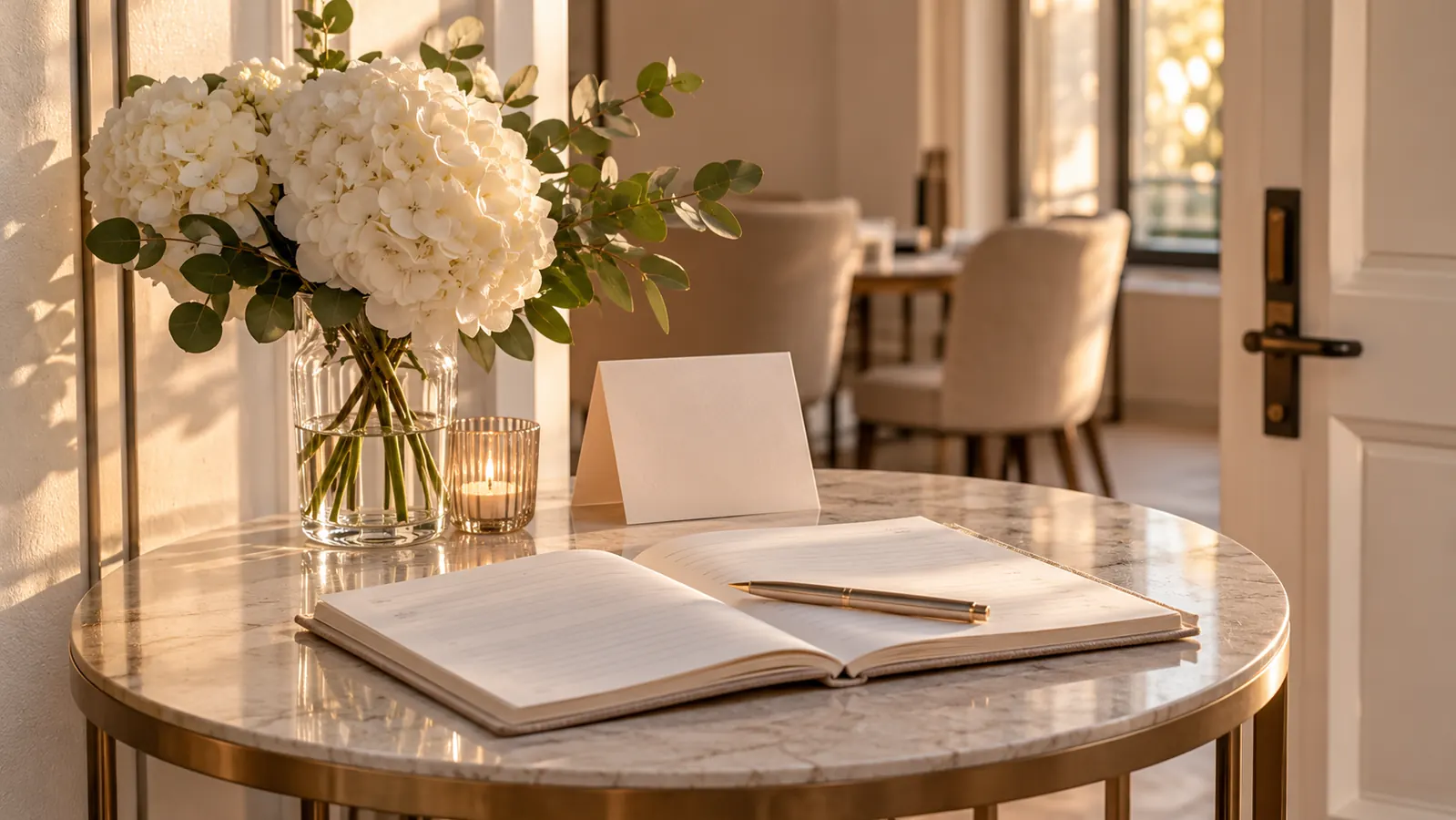
The guest book table is the smallest table at your reception, and it is the only one whose contents you will still be holding ten years from now. The cake gets eaten. The flowers get left behind. The book comes home with you and keeps working, page after page, every time somebody picks it up off the coffee table.
That is the argument for spending twenty minutes planning it instead of setting the book down wherever there happens to be a flat surface. When my daughter Elise chose the ZICOTO guest book in March, I ordered it that week and put it back in its box until June. What actually made it work on the night of June 13 was a table plan, a sign with three lines on it, and someone keeping an eye on the table. Here is the whole setup, in the order I would do it again.
Fifty Blank Sheets, Nine by Seven Inches, and a Spot on Every Page for a Photo
Elise picked this one in March for a 72-guest reception. Linen cover, gold foil lettering, 50 blank sheets, and room on each page for an instant photo and a short note. It sat on a small table by the reception door and came home about two thirds full.
Amazon See the ZICOTO Guest Book on Amazon →Step 1: Pick the Table Before You Pick Anything Else
The right table is the one guests pass on their way in, not the one they find on their way out. Ours was a small table by the reception door, which meant every guest walked past it twice and stopped at least once. Put the book anywhere that requires a detour and you will get half the signatures and a lot of apologetic faces at the end of the night.
Three things to check at the walkthrough. Light first: a window or a lamp within a few feet, because people will be writing standing up and squinting is the fastest way to get a one-word note. Traffic second: not beside the speakers, not at the end of the buffet line, and not on the gift table where the cards are piled, since the two get muddled and somebody ends up writing inside your card envelope. Room third: space for two people to stand side by side without holding up the line, and a surface that does not wobble when somebody leans on it to write. A tall cocktail table does not work no matter how good it looks in the corner. People need to sit or at least perch.
If the venue gives you one long table for gifts, cards, favors and the book, take it and then divide it. Cards at one end, favors at the other, book in the middle with nothing else within arm's reach. Guests treat a crowded table as a pile and a clear table as an instruction. The book needs about two feet of empty space around it or it reads as decoration.
Step 2: Match the Book to Your Guest Count and Your Photo Plan
Fifty blank sheets sounds generous until you do the arithmetic. We had 72 guests, and couples and families share a page, so ours came to thirty four sheets. That left room for a photo and a few lines on each. If your list runs past a hundred, decide early whether you are doing a page per household or letting people share a spread, because the book will not grow to meet the crowd.
The ZICOTO book is 9 by 7 inches and a little under two thirds of an inch thick, 13.7 ounces, with 50 blank sheets and a space on each page for an instant photo. The size matters more than it sounds. A book that size sits open and flat on the table without anybody holding it, which is the whole game. A smaller book snaps shut between guests and people give up. A much bigger one eats the table and leaves nowhere to put the camera and the sign.
Do a test page before the wedding. Take one instant photo, let it develop the full time, and see how it sits next to handwriting. Instant prints are thick, they do not lie flat against a thin page, and they will not stay put on their own. Plan on photo corners or a strip of tape rather than hoping the page presses down.
Step 3: Build One Bag That Holds Everything the Table Needs
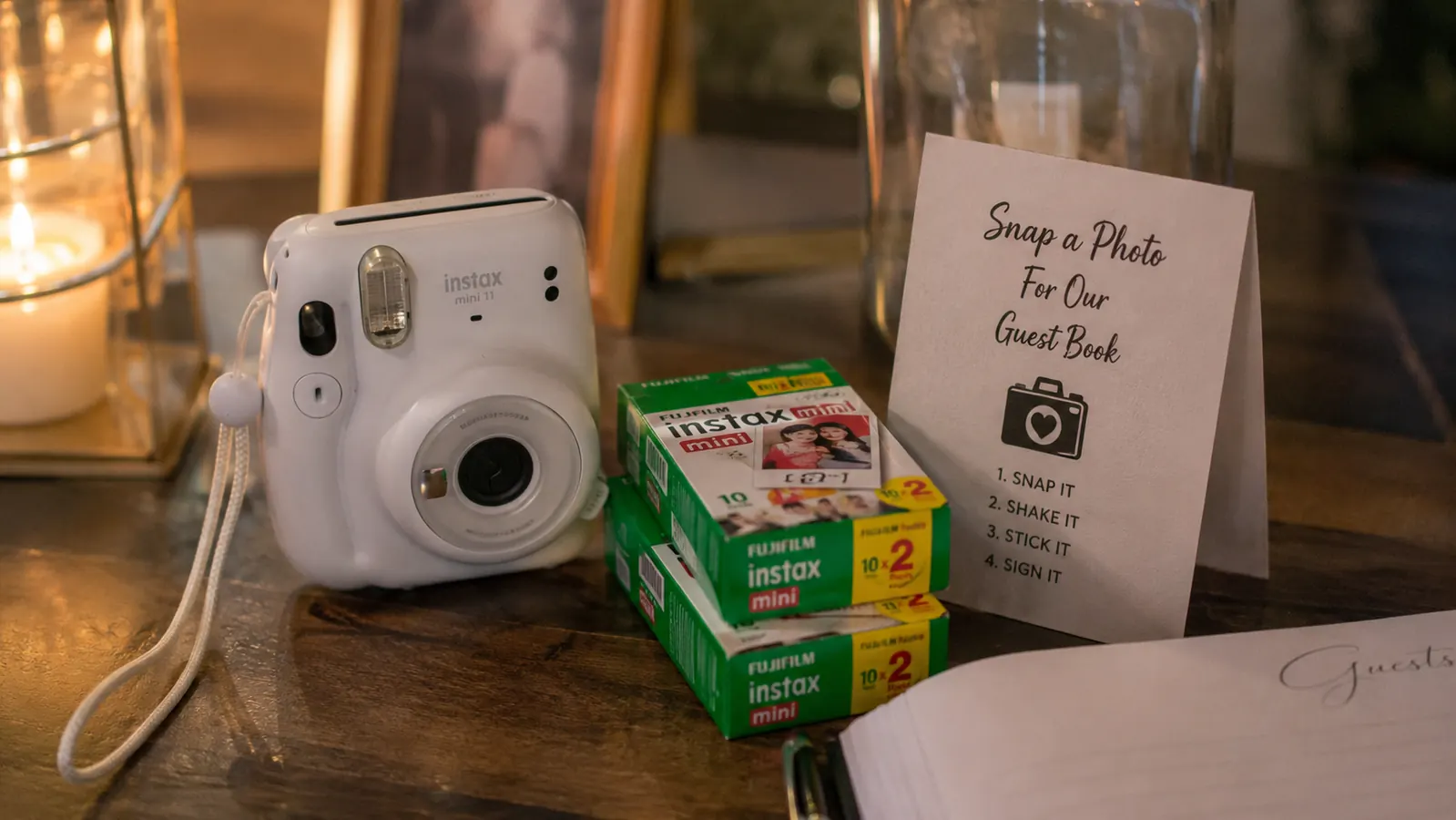
The table needs more than a book, and all of it should live in one box that goes to the venue with whoever is setting up. A cup of fine-point pens, because one pen is never enough. The camera and two packs of film, which is a conversation to have with the person lending it to you. Photo corners or a small roll of tape. A cloth for the table. And the sign, which gets its own step.
One pen is not enough, which is why ours sat in a cup. Film is the same arithmetic: a pack of instant film only goes so far with 72 guests, and the person who owns the camera is the person to ask. Ben's sister lent us hers with two packs of film, which was enough.
Keep the box itself plain and labeled, because a wedding day is full of boxes that look alike. Mine had a strip of tape on the lid and my name in marker. The book itself rode out in my carry-on with the sewing kit, which meant it was in the room while the chairs were still being set, not in a suitcase under a table in the lobby.
Step 4: Write a Sign With Three Instructions, Not Five
Guests freeze in front of a blank book. Not because they do not want to write something, but because they do not know the format. Is it a signature, a message, a photo, all three? A small sign takes the freeze away. Keep it to three lines, put it at eye level, which means propped against something rather than lying flat on the table.
Mine read: take a photo with the camera, write us a note beside it, sign your names. That is the whole thing. No poem, no quote about love, no instructions in a script font that takes a second read to decode. If you want more than names, add a fourth line as a prompt, something like 'tell us where we should go next' or 'the one thing you should know about marriage is.' Prompts work. Vague invitations do not, and you will end up with fifty pages of signatures and nothing to read on a Sunday afternoon.
Step 5: Rehearse the Setup, Then Hand Off Exactly One Job
At the walkthrough, set the table exactly the way you want it and take a photograph of it on your phone. On the day you will be doing four other things and you will not remember whether the sign sat on the left or the right of the book. The photo settles it in five seconds and saves a conversation with a venue coordinator who has her own ideas about where things go.
Then give the table to one person. Not the whole bridal party, not whoever happens to be nearby. One person who checks that the camera has film, that the pens are capped, and that the book has not been shifted to make room for a centerpiece. I kept the book in my carry-on until the table was set, and then I let it go, which is the right order. If you are the mother of the bride, the letting go is the hard part, and it is also most of the job for the last two hours before the doors open.
Seventy-two guests came to thirty four sheets once couples and families shared a page, and that is only if everyone stops on the way in instead of promising to do it later. Fifty sheets is enough book. Fifty sheets on an unmarked table is not.
What Else Helps
The guest book table is a paper table, and paper tables get messy fast. Keep the place cards somewhere else. We used 72 of the Toncoo place cards, gold foil border, tent fold, 3.5 by 2 inches folded, hand-written over two evenings in May, and the leftovers labeled the dessert table. All of that belongs at the tables and at the buffet, not stacked beside the guest book where somebody will pick one up and write a note on the back of it.
The day-of bag is the other half of the setup. Mine carried the Fiskars 27-piece travel sewing kit in its hard orange case, with the folding stainless steel scissors, the 39-inch measuring tape, threads, hand needles, safety pins, straight pins, buttons and a needle threader. It came out that day for a hem about forty minutes before the ceremony and had nothing to do with the guest book, which is the point. One bag for repairs, one box for the table, and no hunting through either at the wrong moment.
The binder is the third piece, and it is the one people skip. The Knot planner we bought the first week of December held our guest list and the RSVP count, which is how I knew 72 was the number to plan the book around. Check that number against your sheets before you order the ZICOTO book, not after it arrives in the mail with fifty pages and a guest list of a hundred and ten.
Timing the Setup on the Day
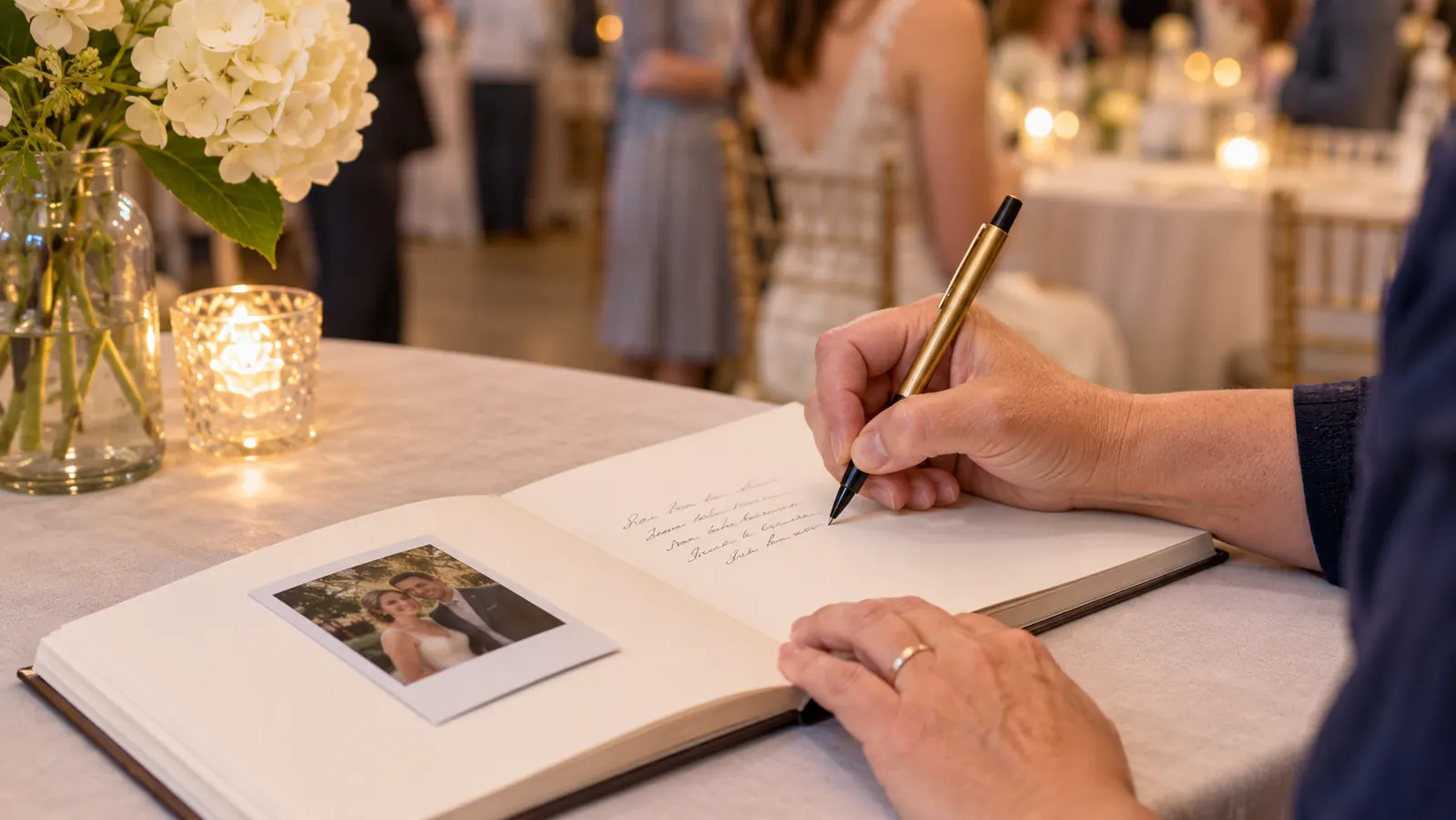
Set the book table before the doors open, not while people are finding their seats. If the room is being flipped between the ceremony and dinner, you are setting it during cocktail hour with the staff, which is fine as long as you get there first. I set ours before the place cards went down, so I had the whole table to myself and could stand back and look at it from where a guest would approach.
Check it once more about an hour into the reception. Not to fuss with it, just to look. The sign has usually slid sideways, the camera has been moved, and the pen that was on the page is now somewhere near the salt shakers. Ninety seconds of straightening at the right moment is worth more than an hour of preparation at the wrong one.
What You Do Not Need on That Table
You do not need a pen stand, a basket of confetti, a framed poem, or a little dish of mints. Every extra object on a small table is one more thing a guest has to move before they can write, and one more thing that can end up on the floor. Book, camera, pens, sign. That is a complete table.
You also do not need a second book for the welcome party, unless you genuinely want two and have room in your luggage for both. One ZICOTO book filled to the last ten pages does more for you than two books half done. And you do not need a calligrapher to write the first page. Write it yourself, imperfectly, so the guests can see that it is not a performance.
One Small Table, Fifty Sheets, and Something to Read on a Slow Sunday
Elise chose this one in March and it came home about two thirds full. Linen cover with gold foil lettering, 50 blank sheets, 9 by 7 inches, a space on every page for an instant photo. It lives on their coffee table now, and we read through it together on visits.
Amazon See the ZICOTO Guest Book on Amazon →