

I ordered the ZICOTO guest book in March for my daughter Elise, opened it at the kitchen table that week, and set it down. It made a small solid sound, and the only question I had left was whether fifty sheets would cover seventy-two people.
Here is where we were. Elise and Ben were married on Saturday, June 13, at a small inn outside Santa Fe, 72 guests at nine round tables of eight. No planner. I ran the binder, the place cards and the day-of bag. Elise chose the dress, and she chose the guest book, and the guest book was this one. We set it on a small table by the reception door with a camera borrowed from Ben's sister, so guests could take an instant photo and write beside it. That is the entire job of a guest book. It either makes that easy for someone holding a drink and a plate, or it makes it awkward in front of everybody.
The Quick Verdict
Fifty blank sheets, a linen cover, and a binding that stays open when a guest writes standing up. It came through 72 guests with the corners still square. Bring more than one pen.
Amazon Check Today's Price →The book that sat by the reception door and did its job
Elise picked it in March. It arrived flat, needed nothing assembled, and filled faster than either of us expected. Current price and availability are on the listing.
Amazon Check Today's Price on Amazon →How I've Used It
Elise found the ZICOTO listing on her laptop in March and showed me, and I ordered it that week. It arrived flat, wrapped in a sleeve, with nothing to assemble. I opened it at the kitchen table, held it open at the middle to check the binding, and put it back in the box until June. That is the least glamorous sentence in this review and the most useful one. There is nothing to do to this book. No pages to punch, no inserts to slide in, no cover to fit into a sleeve. It comes ready, which is not true of most of what you order for a wedding.
That really was all the attention it needed. When it came out of the box in June it looked exactly as it had in March.
On the day, we put it on a small table about six feet from the reception door, next to a basket of instant film and a cup of pens I had brought from home. People signed on the way in, which surprised me. I expected the table to be a stop on the way out, when the room had thinned and nobody was in a hurry to be anywhere. Instead the first handful of guests wrote before they found their seats, and then it drew a small crowd, and by the time dinner was served there were plenty of entries in it. The photo spaces did that. People wanted a picture while they still looked good and the light was still up.
The table stayed where we put it, by the reception door, and the book stayed where it was set down, because it is flat and heavy enough not to slide. If you are the person doing the setup, that is the sort of detail you end up grateful for without ever mentioning.
One small tip. Guests pass a pen back and forth all night, so put a few in a cup on the table and do not think about it again.
After the wedding it went into a tote bag and flew home with me on Monday. Elise carried it to their apartment from there, and it lives on their coffee table now. Paul and I reread it with her when we visit. That sounds like a small thing to say about an object you order in March. It is not small. It gets picked up for no reason at all.
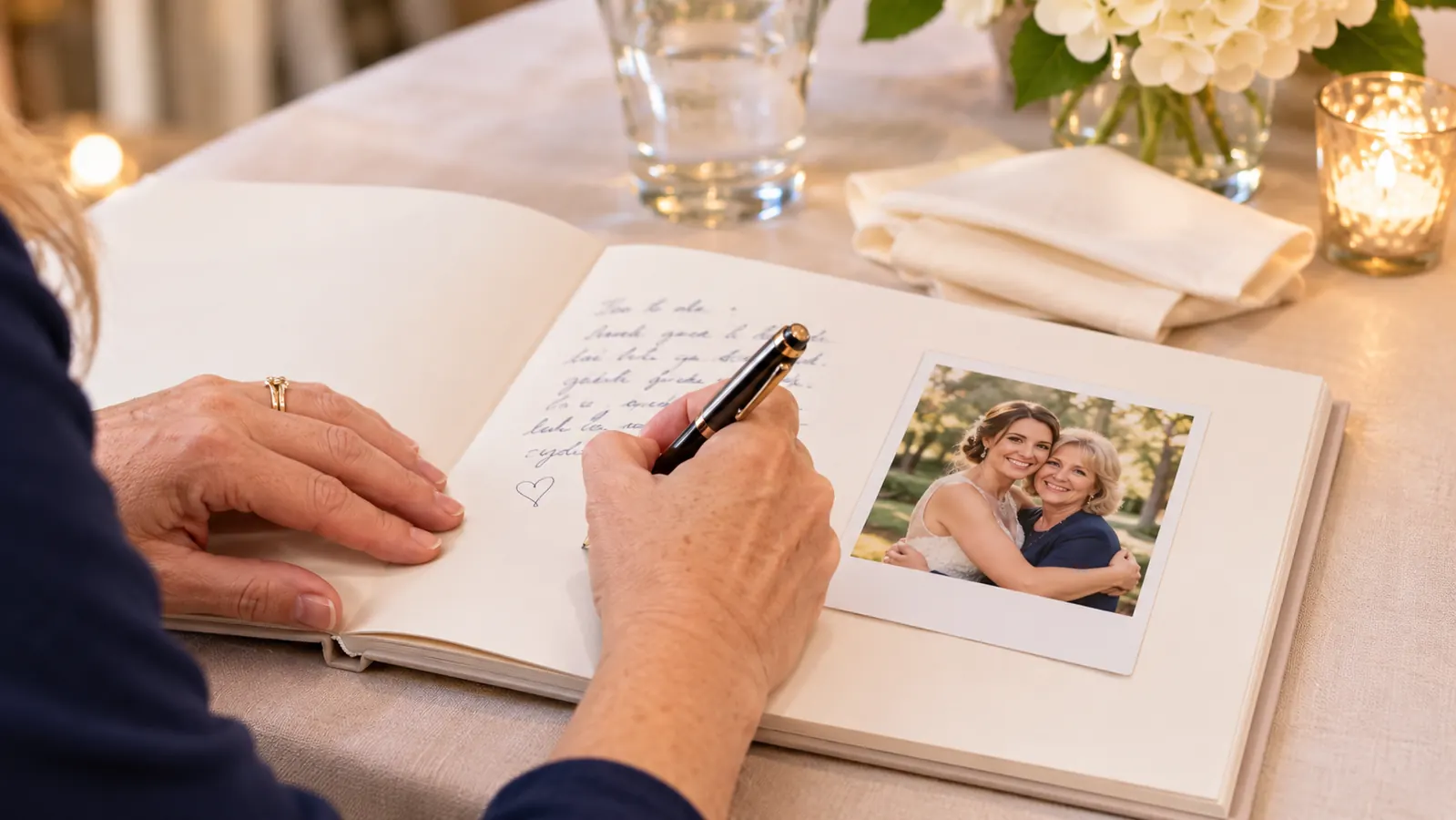
Fifty Blank Sheets and the Question of 72 Guests
Fifty blank sheets sounds generous until you are looking at a guest list of 72 and doing arithmetic in your head at the kitchen table. Here is what actually happened. Couples signed one entry together. Families with two small children signed one entry with four names on it. People deep in conversation at the dessert table signed late and signed short. By the end of the night the book was roughly two thirds full, with empty sheets left at the back.
I counted the used sheets on a visit to Elise and Ben after the wedding, sitting on their living room floor with the book open on the rug and a cup of coffee going cold beside me. Thirty four. Of those, nineteen had a photo tucked into the space beside the writing. The other fifteen were writing alone, and I could name the reason for most of them: the camera was across the room, somebody had already sat down, a few people simply preferred to write. Nineteen out of thirty four is not a failure. It is what a room full of people actually does, and the book was built so the other fifteen still looked finished.
The photo spaces are what earn the book its keep. There is a spot beside the writing for an instant photo, and the layout assumes you will use it. When someone remembered to take a picture, the page filled in a way that a signature alone never manages. When someone forgot, the space stayed empty and the entry still read fine. That is better design than it sounds. It means a guest who does not want to be photographed, or who could not get near the camera, still leaves something worth reading.
The pages themselves are blank. No prompts, no lines, no question printed at the top of the sheet asking for marriage advice. I thought I would mind that and I did not. Blank means a guest who wants to write a paragraph writes a paragraph, and a guest who wants to sign a name signs a name, and neither of them is being corrected by the page. The trade is that shy people will write two words and hand the book on. If your family runs shy, know that going in.
What surprised me most is which entries we come back to. Not the long ones. The four words from Ben's uncle, with a small drawing underneath, have been read aloud twice now. With no prompts to live up to, people wrote what they actually thought, and a fair amount of it is funnier than anything a printed page would have asked them for.
The Cover, the Size and the Weight of It
The ZICOTO book is 9 by 7 inches and 0.63 inches thick, and it weighs 13.7 ounces. Numbers on a listing page do nothing for anybody. In the hand, 9 by 7 is the size of a hardcover novel, which means it lies open on a table without you holding it and it does not read as a register you sign at a doctor's office. For scale, the planning binder I carried for six months is a two-and-three-quarter pound object you lift with two hands. The guest book is a book you pick up with one.
The cover is a linen cloth with gold foil lettering, and the foil was the part I expected to disappoint me. Foil in a listing photo is usually a print that catches the light wrong in person. This one catches light. On that table by the door, under the string lights the inn had up, it looked like a piece of the wedding rather than an office supply. I am aware of how that sounds coming from me. I am also the person who would have told you it did not matter.
The weight matters more than I expected on the setup afternoon. I carried that book, the cup of pens and the two packs of film across a gravel courtyard in one trip, and it was the book that kept the whole stack from sliding off the box I had balanced everything on. A shade under fourteen ounces is not a number anybody puts on a wedding checklist. It is the reason the book stayed flat on a folding table all night instead of walking around every time somebody leaned on it.
We did look at the other style, the kind where the photos are the pages themselves and the writing is squeezed around them. I saw one on a shelf at a stationery shop in Savannah and looked at two more listings with Elise. That kind asks a great deal of your guests and it is unforgiving if the camera runs out of film. What we chose is the calmer version of the same idea. One book, one spot per entry, and a page that still works when the photo never happens.
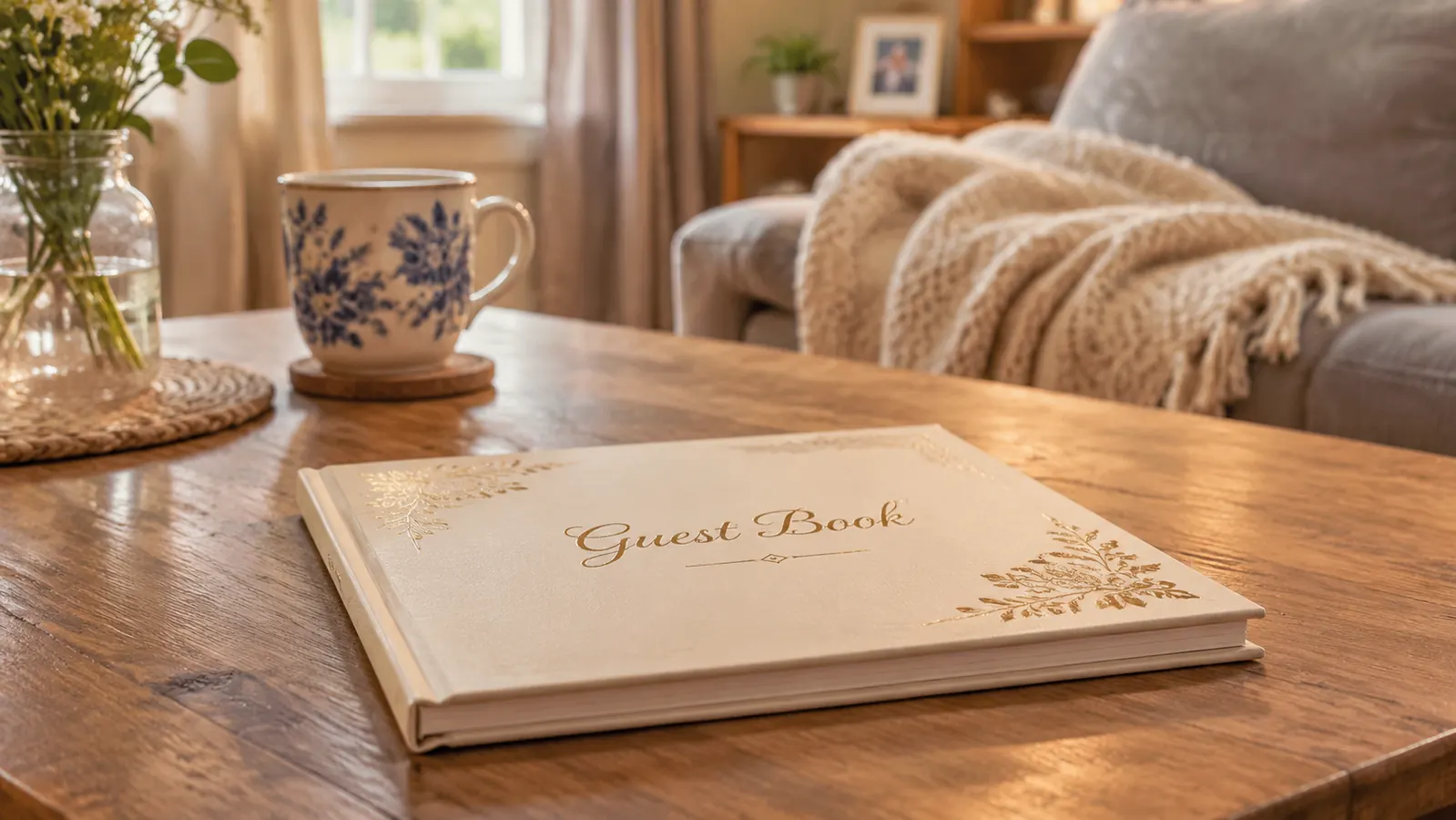
How It Held Up on the Night and After
Nothing happened to it. I want to be plain about that, because a review where the object survives some dramatic near miss is not a review, it is a story. The ZICOTO book sat on a table for about five hours, was picked up and set down by 72 people, rode home in a tote bag and then a carry-on, and was handed around an apartment afterward. No page tore at the binding. The cover came out with no marks I could find. The corners are still square. A guest book that goes through a reception and looks like it went through a reception is a bad guest book, and this one does not.
The structural thing worth knowing is that the binding holds the book open flat by itself. That matters more than it sounds. People write standing up, holding a plate, with one hand free. A book that flops closed takes two hands and gets abandoned. I watched guests set it down, write four lines, take their hand away, and the book stayed exactly where they left it. That is the whole difference between a guest book that fills up and one that sits empty until the last twenty minutes of the night.
The one thing I would check on arrival is the corner where the cover folds back. Ours was tight from the start and stayed tight, but a cover that arrives soft at that edge is the thing that eventually separates, and you will see it in the first ten seconds with the book in your hands. If yours arrives with a loose fold, send it back while there is still a month on the calendar. That is not a knock on the book. It is the one inspection I would do on any cloth cover I ordered.
What I Liked
- Fifty blank sheets covered 72 guests with roughly a third of the book still empty
- Binding holds the book open flat, so a guest can write standing up with one hand
- Photo spaces beside the writing turn a signature into an entry you reread
- 9 by 7 inches and 13.7 ounces: reads as a book, carries in one hand
- Linen cover with gold foil lettering looks like part of the wedding, not an office supply
Where It Falls Short
- No pen included, and one pen is not enough for 72 guests
- Blank pages mean no prompts, so shy guests wrote two words and stopped
- The photo spaces only pay off if someone remembers a camera and enough film
- Fifty sheets gets tight for a wedding well past 120 guests signing individually
Five hours on a table by the door, 72 people, one hand free each. No page tore at the binding and the corners are still square.
Who This Is For
This is for the couple planning without a planner, the ones doing arithmetic on a laptop at eleven at night. It is for a wedding in the 50 to 120 guest range where you want something that gets picked up again rather than a signature list that goes into a drawer. It suits a bride who wants the book to look like it belongs on the table and does not want to think about it again after March. It also suits the mother of the bride, who is usually the one actually placing the order, because there is nothing to assemble, nothing to check twice, and nothing that can arrive in pieces.
Who Should Skip It
Skip it if you are expecting 200 guests and want every one of them to write a separate entry, because fifty sheets will not stretch and you will spend the reception doing math in your head. Skip it if you want prompts, questions, or a printed page for each guest to fill in, because there are none here, just blank sheets and photo spaces. And skip it if nobody in your circle owns a camera that prints instantly. The photo spaces are half the point, and a book full of empty photo spaces looks like something that did not happen.
What I would tell you if you were standing in my kitchen: order the ZICOTO book early, open the box when it comes so you are not surprised in June, and put a cup of pens on the table instead of one. The book will do the rest of the work on its own. It is on Elise and Ben's coffee table right now, and I have watched four separate visitors pick it up without being asked.
Order it early and set out a cup of pens
Fifty blank sheets, a photo space beside the writing on every entry, and a cover that looks like it belongs on the table. Check today's price and current availability before your date gets close.
Amazon Check Today's Price on Amazon →