
Tess came around the corner at the inn about forty minutes before the ceremony with a length of hem hanging off her fingers. The stitching along the back seam had let go for maybe eight inches. My daughter Elise was inside having her lipstick touched up. Seventy-two guests were somewhere on the property. Nobody was watching Tess. That was the only good news, and I had about a minute to decide whether this was a disaster or a small job. It was a small job. It was a small job because I had packed for it in May.
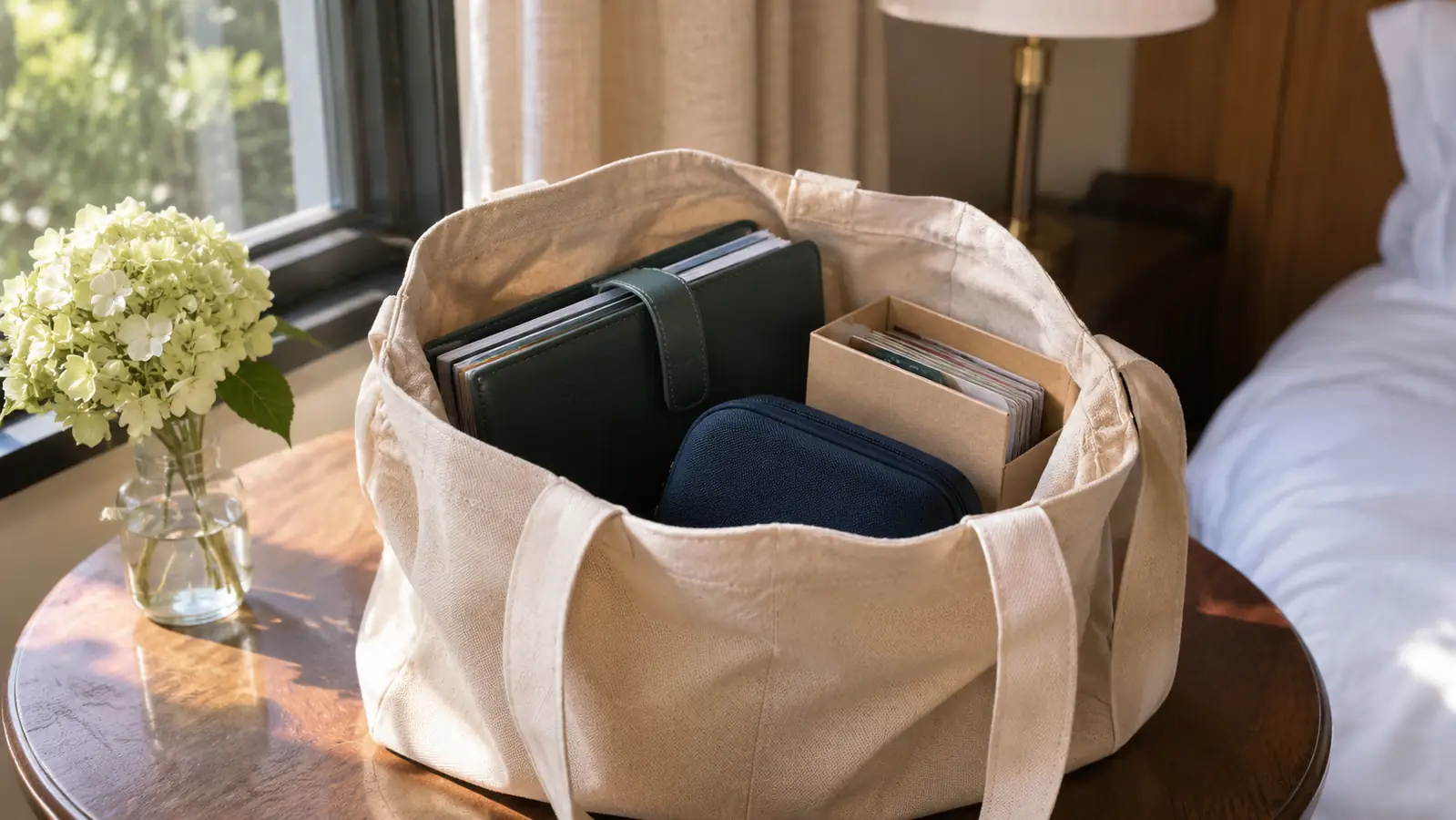
I am not a seamstress. I am a retired school office manager from Savannah who sews basic hems and nothing more, and I will not pretend otherwise. What I am is a person who kept a wedding planner binder open on the kitchen table for six and a half months and wrote a day-of bag list in the back of it. Item one on that list was the Fiskars 27-Piece Travel Sewing Kit: folding scissors, a 39-inch measuring tape, colored threads, hand needles, safety pins, straight pins, buttons, and a needle threader, all in a hard case that fits in a tote. It went into my carry-on in June and flew with me from Savannah to Albuquerque by way of Dallas, folding scissors and all. Check your own airline's current rules before you count on that, but it went through security twice without a word. When Tess needed it, it was in the tote within arm's reach.
One small case, 27 pieces, and a hem saved forty minutes before the aisle
The Fiskars travel sewing kit is the piece of the day-of bag I would pack first: folding stainless steel scissors, a 39-inch measuring tape, colored threads, hand needles, safety pins, straight pins, buttons and a needle threader in a hard case that fits in a tote and survived a carry-on.
Amazon Check Today's Price on Amazon →Here is the order I would do it in. I would also practice the first two steps once at home, in daylight, on a dish towel, because the morning of a wedding is not the time to learn where the needle threader lives. It takes eight minutes and it is the difference between a mother of the bride who is calm and one who is not.
Step 1: Put the kit in the bag you will actually be carrying
The Fiskars case does nothing in a suitcase. It is easy to see how this goes: the supplies are neatly zipped inside the luggage that got left at the front desk, and the person who needs them is on the far side of a lawn. My case went into the flat tote I carried from Wednesday onward, with the small pouch of wipes and blotting papers I had put together. If you are the mother of the bride, or the bride, that tote is your job for the week. Nothing in it should be checked, borrowed, or handed to a cousin to hold.
Open the case before you zip the tote. The pieces sit in the hard shell in their own places, and you want to know what those places look like before you are looking at them in a dim room with someone crying. Unroll the 39-inch tape and look at it. Pull one of the hand needles out and put it back. Find the needle threader and hold it up. That small act of familiarity is worth more on the day than twenty extra items you have never touched.
Two things I would add to the case yourself: a small envelope of safety pins kept separate from the ones in the kit, and a folded paper towel. The pins because you will hand them out and not get them back, and the paper towel because an inn floor is not where you want a dress resting. Then practice once, in your kitchen, on a dish towel: open the case, thread a needle with the threader, take four small stitches into a folded edge, and tie off. Eight minutes, and it teaches your hands the two motions that matter.
Step 2: Take the dress off before you touch it
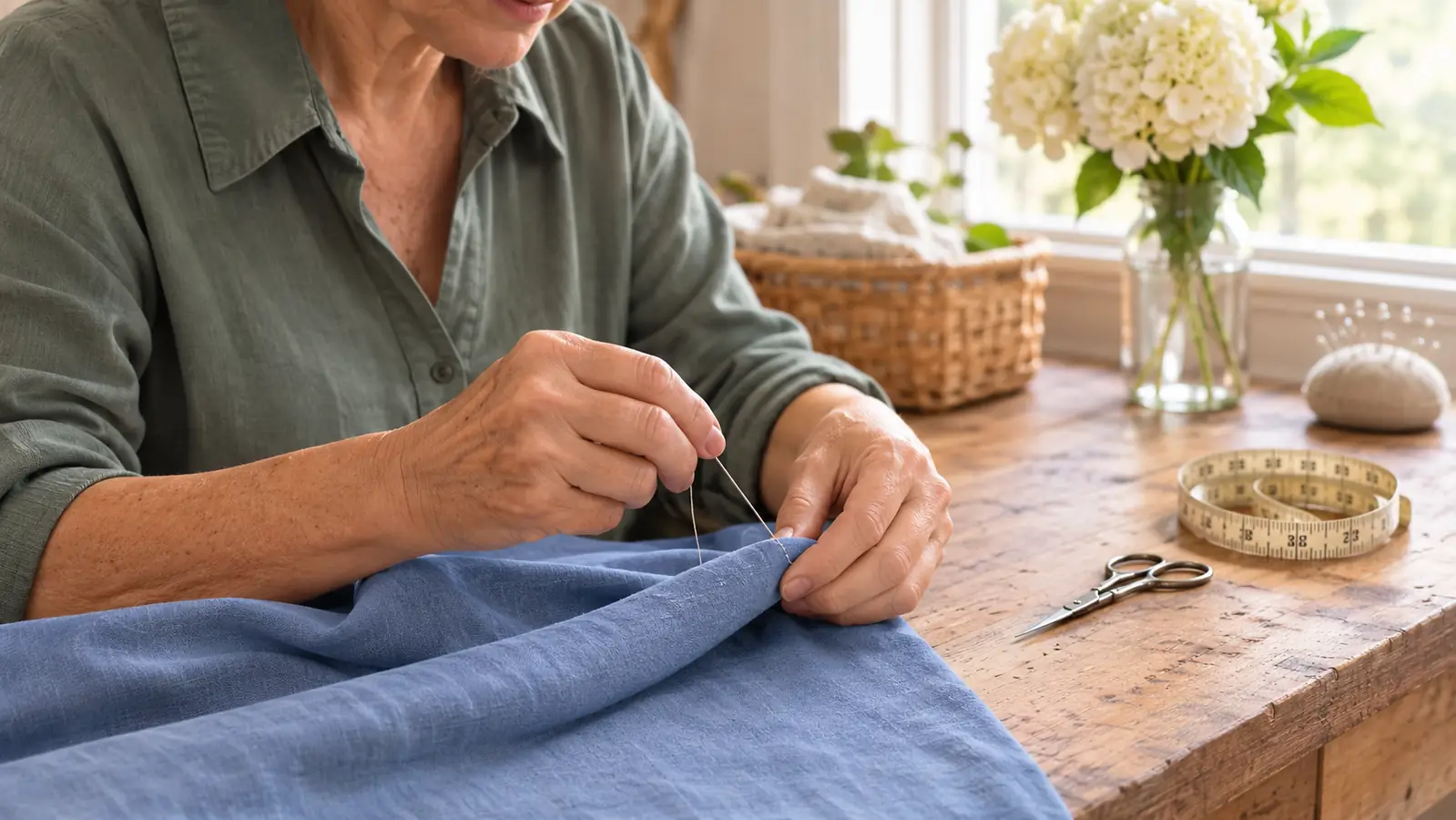
Every instinct says fix it while she is standing there, with a bridesmaid holding up a phone flashlight. If you have a side room and a few spare minutes, do not. A hem stitched on a body is stretched by the body inside it, and it can hang wrong the moment she walks. Getting her out and the dress flat on a table takes about ninety seconds. We did not have that luxury. Tess held the skirt up and stood very still, and I worked from the inside on my knees, slowly, with a finger between the needle and her leg.
Turn the garment inside out and find the crease where the original hem was turned up. It is nearly always still there, a soft line pressed in by whoever sewed it in the first place. That crease is your pattern. Lay the fabric flat, not draped over a chair back, not held up in the air. If the inn has a long table in a side room, that table is now your workbench, and everything else on it can go on the floor.
Give yourself a number before you start. Mine was the ceremony at four, and the repair itself took eleven minutes. Whatever your number is, keep it. A hem that is ninety percent done when the processional starts is a hem that is not done, and a half-finished repair looks worse than the original tear.
Step 3: Match the thread, then thread the needle the easy way
The kit carries colored threads, and the closest match is almost always good enough. On a hem, a whisper off in either direction reads as shadow from any normal distance. If you are stuck between two, choose the darker one. A too-light thread on a light dress catches the light and announces itself from across a room, which is the one thing a repair cannot do.
Thread the needle with the needle threader rather than squinting at it. You push the little wire loop through the eye of the needle, drop the end of the thread through the loop, and pull the wire back out, and the thread comes with it. I can thread a needle by eye on a calm day and I still reach for the threader when my hands are not steady, and on a wedding day nobody's hands are steady.
Double the thread and knot the end. Cut about eighteen inches, not more, because long thread tangles and you will spend your time undoing knots. Open the folding scissors and use the tips to cut close to the knot, so you are not sawing at the thread with the middle of the blade.

Step 4: Stitch it so it holds through the reception
Work from the inside. Bring the needle up through the fold of the hem, take a tiny bite of the dress fabric directly above it, maybe two threads deep, and pull through. Then take another small bite of the hem fold a quarter inch along. That is the whole stitch. Small bites on both sides, close together, and the repair disappears into the shadow of the fold. Do not run a long visible line across the front of a dress. It will hold, and it will look like a repair from twenty feet.
Anchor both ends. Two backstitches at the start and two at the finish, knotted on the inside, and cut the tail short so no thread hangs below the hemline. The most common failure is a hem that is stitched beautifully and comes apart at one end because the start was never anchored. Then check your tension. If the fabric puckers, you pulled too hard. The hem should lie flat with the dress hanging free, and if it does not, cut it out and start again. Thread is replaceable and minutes are not.
Then make her walk. Have her walk the length of the room, sit down in a chair, and stand back up, because sitting is what pulls a hem loose and she will sit at least nine times before the night is over. If it holds through that, it will hold through the aisle.
Step 5: Check the hem and put the case back where you found it
The stitching leaves a faint line where you worked, and a dress that has been laid flat will hold a fold. Hang it in the bathroom with the door closed and the shower running hot for a few minutes and let the steam do the work. That is the same trick that relaxed the one soft fold the dress picked up in the garment bag on the flight out, and it worked by Friday without anyone touching an iron.
Close the case and put it back in the tote. Then walk away. The remaining minutes belong to the person getting married, not to the sewing kit.
The rest of the kit came home almost entirely unused. I used thread, one needle, the threader and the folding scissors. Everything else, the buttons, the pins, the tape, went back into the hard case and into the hall closet, where it still is. That is the correct outcome and I would pack it again tomorrow.
What Else Helps
A second pair of hands and a phone flashlight are worth more than any single item in the case. Good light and a steady friend beat a good seamstress working alone in a dim room. Pick that person in advance. Tell them at the rehearsal dinner that if something goes wrong with a hem, they are the one holding the light. Nobody volunteers in the moment.
Beyond the Fiskars kit, the only other thing in the tote was a small pouch of wipes and blotting papers I put together myself, and that was plenty. What I did not need was a large emergency kit. I looked at those on a shelf at the bridal shop in Savannah and thought about how much of it I would never open. Twenty-seven pieces I understood beat a box I did not.
One more thing, and it is not about sewing. Whatever goes wrong on the day will feel enormous to the person it is happening to and small to everyone else, and you are usually the one holding both of those at once. Decide in advance that you will be calm about it. The kit only works if the person carrying it is not the person panicking.
If you are the bride and not the mother, hand the tote to someone else that morning. You cannot be the person holding the light and the person in the dress. I packed the bag before we left and Elise never had to think about it, and that is exactly how it should work.
Eight inches of hem, eleven minutes, one needle and a spool of thread. She walked at four o'clock and nobody in those seventy-two chairs looked at her feet.
Buy it in May, open it in your kitchen, and know where it is standing on the day
A hard case with folding stainless steel scissors, a 39-inch measuring tape, colored threads, hand needles, safety pins, straight pins, buttons and a needle threader. Small enough for a tote, sturdy enough for a carry-on, and 27 pieces you can actually find in a dim room.
Amazon Check Today's Price on Amazon →